

Smart data management and AI: Building better decisions in business schools
Business schools have never lacked data. They collect information about students, programmes, faculty, research outputs, corporate engagement, alumni, finances, learning outcomes, rankings, and accreditation indicators.
The challenge is not the absence of data, but how fragmented, inconsistent, and underused it often becomes once it starts travelling across systems and departments.
At the same time, expectations from stakeholders continue to rise. Accreditation frameworks require evidence and transparency. Rankings demand structured datasets and consistent definitions. Institutional leadership needs reliable reporting to support strategic decisions. And many schools are now being asked to show measurable impact, not only activity.
In this environment, data management is no longer a technical back-office function. It is part of institutional governance.
From collecting data to managing it
Many institutions still treat data work as something that happens “when needed”: during accreditation preparation, ranking submissions, annual reporting, or audits. The result is a familiar pattern — rushed data collection, manual spreadsheets, duplicated work, unclear ownership, and last-minute quality checks.
Smart data management means shifting from this reactive approach to a structured one. It is not about collecting more data, but about making sure that the data you already have is trustworthy and usable.
This begins with simple but often neglected questions:
- What counts as “faculty” or “international experience” in our reporting?
- Do different departments use the same definitions?
- Where is the source of truth for key metrics?
- Who owns each dataset, and who validates it?
Without clarity on these fundamentals, even sophisticated dashboards or AI tools will only amplify confusion.
Data governance: the missing link
Strong data management relies on governance — not in the sense of heavy bureaucracy, but in establishing responsibility, consistency, and shared understanding. Good governance defines who collects what, when updates are made, and how errors are corrected. It also creates a culture where people trust institutional data rather than questioning every number.
In business schools, governance can be difficult because data is distributed. Academic units hold programme information. HR manages staff data. Quality offices track learning outcomes. Careers teams collect placement statistics. External relations units gather corporate engagement metrics. Each area has its own priorities and formats.
A governance framework helps connect these pieces. It creates alignment and reduces duplication. Most importantly, it makes reporting faster and more reliable.
Where AI becomes useful (and where it doesn’t)
Artificial intelligence is often presented as a solution to data challenges. In reality, AI is only as strong as the data it works with. If institutional datasets are incomplete, inconsistent, or poorly structured, AI will not solve the problem — it will produce outputs that look convincing but may be misleading.
However, once good data foundations are in place, AI can genuinely improve efficiency and insight.
For example, AI tools can support schools by:
- summarising large volumes of institutional reporting data into clear narratives
- identifying patterns in student satisfaction or learning outcomes
- detecting inconsistencies or missing values across datasets
- supporting scenario planning by modelling trends over time
- accelerating the production of reports for internal decision-making
In many cases, AI does not replace analytical work, but it reduces repetitive tasks. Instead of spending hours compiling tables, staff can focus more on interpretation, context, and decision-making.
The growing importance of data storytelling
A key skill for institutions is not only analysing data but also communicating it. Leadership teams, accreditation panels, faculty committees, and external partners rarely want raw numbers. They want meaning.
Data storytelling is the bridge between evidence and action. It connects trends to strategic questions: What is improving? What is declining? What should we prioritise? What risks do we need to address?
AI can assist in generating first drafts of narratives or visual explanations, but the institutional story still requires human judgment. Context matters: a dip in applications may be a warning sign, or it may reflect a deliberate shift in recruitment strategy. Numbers do not interpret themselves.
Building data maturity as a strategic capability
Data maturity is often uneven across institutions. Some schools have advanced analytics teams and integrated platforms, while others rely heavily on manual processes. But maturity is not only about technology. It is also about habits: shared definitions, clean workflows, and a culture of evidence-based decision-making.
Progress often starts with modest improvements: mapping existing data sources, standardising key definitions, reducing manual duplication, and establishing a small number of high-quality institutional dashboards that people actually use.
The long-term benefit is clear. Better data management supports accreditation and rankings, but it also strengthens internal planning, resource allocation, and programme development.
A space for shared practice and learning
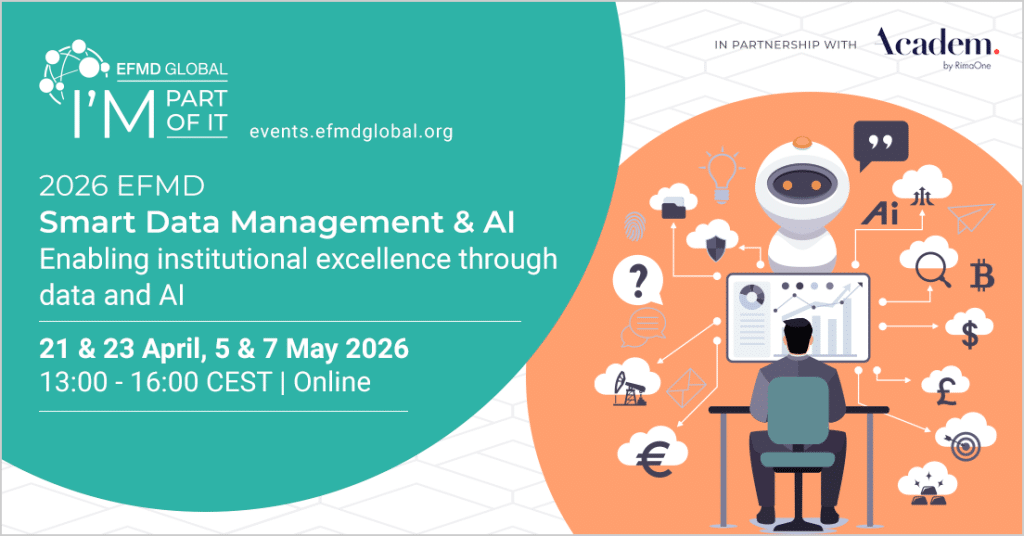
These themes are at the centre of EFMD’s upcoming Smart Data Management & AI Workshop (online, 21 April – 7 May 2026). The workshop is designed for professionals working with institutional data – including accreditation, rankings, quality assurance, and strategic reporting – and focuses on practical approaches to improving data processes and exploring how AI can be applied responsibly in a business school context.
Rather than treating AI as a standalone topic, the workshop connects it to real institutional needs: data quality, governance, reporting, and communication.

Looking ahead
Business schools are entering a period where data is no longer simply an operational requirement. It is part of how institutions define success, demonstrate credibility, and make decisions under uncertainty.
The schools that benefit most from AI will not necessarily be those that adopt tools first, but those that invest in the fundamentals: clear definitions, reliable processes, and people who understand both the technical and strategic dimensions of institutional data.
AI can accelerate analysis, but smart data management is what makes analysis worth trusting.
For additional insights, announcements and perspectives, visit the conversation on Business Education.


