

Embracing challenges in doctoral education: getting ready for an uncertain future

The world of doctoral education is constantly evolving to make sure we offer programmes that deliver graduates that are fit for the job market after finishing their PhD/DBA. To check whether our PhD and DBA programmes meet this ambition and to be inspired by other business schools, we attend the EFMD doctoral programmes conference every year. The 2023 conference was hosted by the Toulouse School of Management. Just as last year (when we were hosting the delegates at the Vlerick campus in Brussels), we took a positive angle by focusing on how we can embrace the challenges facing doctoral education (the conference theme).
Is there a future for doctoral education?
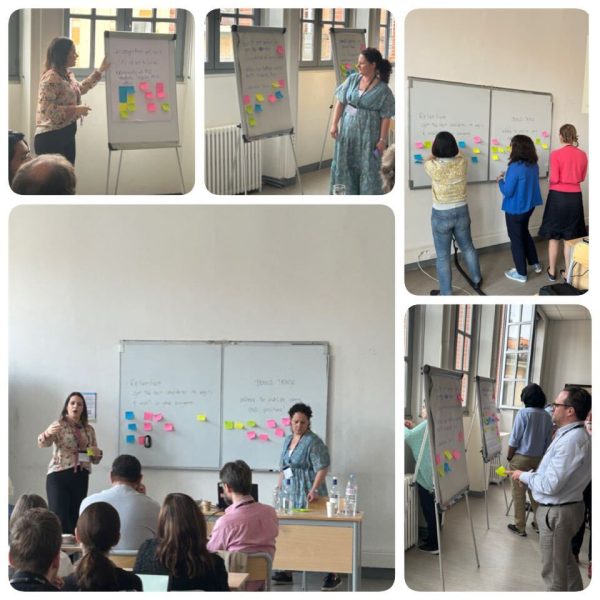
Interestingly, the first keynote (Anne Lee from the University of Bristol) kicked off the conference with the question: “Is there a future for doctoral education?”. No … unless we adapt our programmes to the changing needs and environment. Luckily Carine Peeters (professor in strategy from Vlerick Business School) closed the conference with optimism by preparing delegates for this uncertain future with a scenario planning exercise, making us ready to act confidently towards challenges such as (1) mental health and well-being of all actors in the doctoral ecosystem; (2) the potential impact of technology and generative AI on the relevance of (doctoral) research; (3) variations in demand for doctoral graduates (over- or under-supply); and (4) changing needs in competency and skills development (preparing doctoral students for what purpose).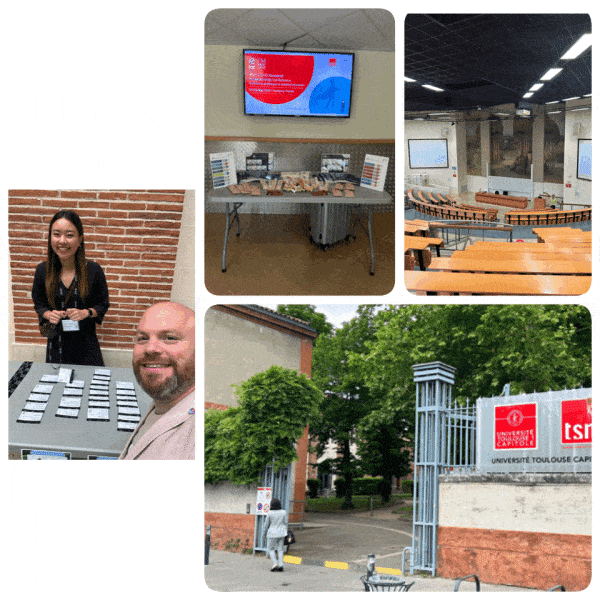
These four topics were also the cornerstone of the three-day conference, which nicely intertwined keynotes, panel conversations, interactive sessions and informal chats. Making a summary of the numerous inspiring exchanges does harm to the rich discussions we had. Anyway, here is an attempt to capture some of my learnings linked to the key challenges of the conference.
Mental health: an ecosystem of care
Build an ecosystem of care to support the well-being and mental health of both doctoral students and supervisors, making sure that all people involved in doctoral education know what their role is and where to leave it to specialists. It is key to clearly distinguish mental distress from mental disorders and draw lines between temporal phases of mental distress and deeper psychological problems. One way to deal with the unavoidable phases of distress that are part of doing academic research is to openly discuss and set the right expectations at the start. While this seems obvious, it is often forgotten. Making doctoral students aware of the actual journey creates openness to vulnerabilities and humanises the process.
There was clearly a huge variation between the schools represented at the conference in the depth and breadth in which mental health services are already developed and available for doctoral students and supervisors alike.
Employability: don’t underestimate your skills
Irrespective of which career doctoral researchers want to pursue after obtaining their degree, they seem to underestimate the huge range of relevant skills they developed in their doctoral journey. Analytical and critical thinking skills are obvious ones (and highly needed in every workplace these days), just as the ability to conceptualise, create new ideas or solve problems. But what about resilience, time management, project management, ability to work independently, presentation skills, writing skills, networking, people management … and we can go on.
To help doctoral students in their further careers, doctoral programmes should include activities that make them self-aware of the incredible (transferable) skills they gain throughout their PhD and how to “sell” them to any future employer (be it academia, business or policy-making).
Generative AI: to use or not to use in doctoral education?
On the last day of the conference, we could no longer ignore the elephant in the room: what about chatGPT? Will generative AI make doctoral programmes and research obsolete? Experiences with using AI differed hugely among delegates, with people with no experience, others using it mainly in their teaching and some also embedding it in their own research or research supervision.
 We debated whether chatGPT (1) can come up with a good research idea (apparently it does: scoring 8/10 according to academic reviewers that made an assessment without knowing it was produced by chatGPT); (2) can be creative (depends on your definition of creativity: it does write poetry, makes art … but problem-solving is not (yet) possible); (3) can write a literature review (be careful, as it seems to write a great piece, but makes up references).
We ended with the potential use of chatGPT in doctoral education and research. How can it be meaningfully and harmlessly used? Some examples: ask it to find weak arguments in a text, make a summary of an academic paper to help you decide whether or not to read the full paper, adapt the writing style of a paper from one journal to another, adapt the abstract from one conference to another (e.g. 2 pages, 5 pages,…). In short: chat GPT can help you to speed up some parts of the research process, but you should always make sure that your results are accountable, verifiable and retraceable. Be critical when using AI-generated output. Be vigilant about (over)sharing your own sensitive/confidential information and data since it is difficult (or even impossible) to track what happens next with your input and who will have access to it.
There is no reason to be afraid of generative AI in doctoral education if you use it wisely (the right question and the right prompting) while at the same time training doctoral students’ critical thinking.
Taking it back to Vlerick
We left the conference with a lot of food for thought to work further on a healthy Vlerick (doctoral) research ecosystem. Specifically for mental health, we were inspired by other schools’ preventative mental health training, mental health toolkits for supervisors and researchers and their centralised information services to guide people to the right support systems. Regarding skills training and making the transition to the future career, we learned we already do well. We will continue offering relevant skills, career and employability activities. We will keep on stimulating our doctoral and DBA students to be mindful of and proud of all skills they achieved during their academic journey in our business school. Lastly, concerning the use of AI in our doctoral programmes and research more broadly, we need to move from exploration and broad experimentation towards a more structured policy and information sharing.
We already look forward to next year’s EFMD doctoral programmes conference at Nova Business School in Portugal.
See other articles related to doctoral education.


