

Leading in times of disruption: Highlights from the 2025 EFMD Deans Conference

On 13-14 February, more than 400 business school leaders from dozens of countries around the world gathered in Lisbon, Portugal, for the EFMD Deans Conference hosted by the Católica Lisbon School of Business and Economics at the Universidade Católica Portuguesa. Read the summary of key insights from sessions addressing leadership in times of disruption.
In response to major shifts in business education, increasing societal accountability and geopolitical uncertainty, business school deans gathered for this year’s conference to address the theme, “Leading In Times of Disruption.”
Through various forums, participants tackled timely topics, sharing insights, challenging conventional wisdom, and collectively exploring strategies to navigate the turbulent waters of modern business education.
Throughout the two days, the agenda was carefully woven to balance both reflective discussions and forward-thinking innovations. Plenary sessions delved into the evolving identity of business schools, examining how market dynamics, shifting curricula, and unexpected crises have reshaped institutional priorities.
A day of new beginnings and bold ideas
The formal proceedings began with a welcome address by EFMD President Eric Cornuel, capturing the essence of the theme by urging leaders not to fear change and reminding them that “we must embody the vision of empathetic and inclusive leadership” in the face of fractures in international cooperation.
-

EFMD President Eric Cornuel delivers the welcome address at the 2025 EFMD Deans Conference, Lisbon, on 13 February.
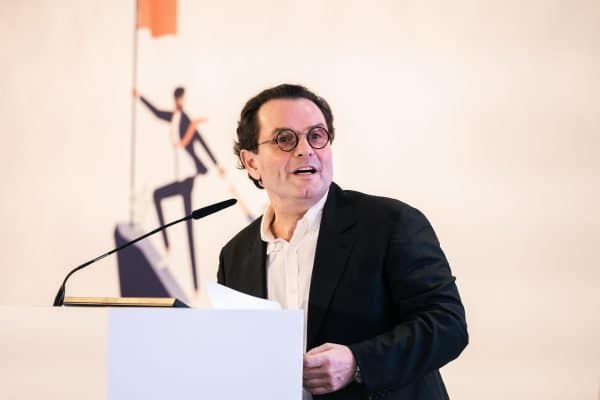
“While challenging, disruption also presents opportunities for innovation and growth. And business education has always been at the forefront of progress and innovation in higher education,” said Cornuel.
In his opening address, Carlos Moedas, the Mayor of Lisbon, emphasised that “there’s nothing you can do if you don’t have impact.” His remarks on embracing diversity and linking innovation to social welfare resonated deeply with participants, further setting the tone for a conference built on the principles of resilience, transformation, and purpose.
-
Isabel Capeloa Gil, Rector and Professor, Universidade Católica Portuguesa
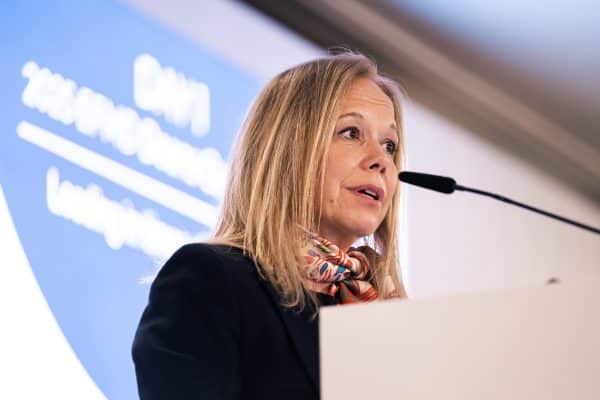
Isabel Capeloa Gil, Rector and Professor, Universidade Católica Portuguesa, noted that although disruption has always been a defining force and that she’s heard “this year is going to be particularly difficult” from deans for 20 years, the upcoming year is certain to be like none other, filled with enormous challenges.
“However, we see disruption as an opportunity,” said Gil.
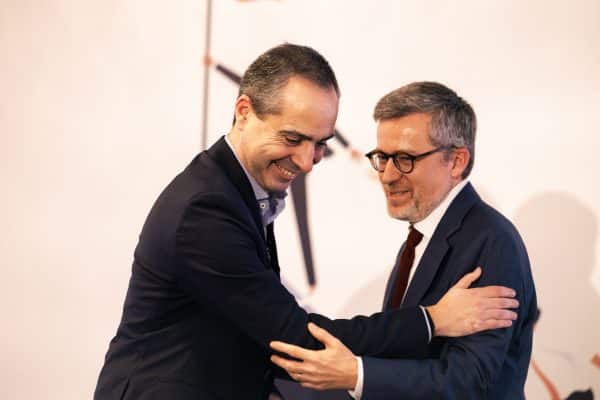
Conference Chairman Filipe Santos, Dean at Católica Lisbon School of Business and Economics, then set the scene by noting that it’s crucial to “understand the past, strengthen the present, prepare for the future.” His insights reminded participants of the critical balance between honouring tradition and pioneering change—a duality that has become essential in today’s disrupted environment.
-
Conference Chairman Filipe Santos, Dean at Católica Lisbon School of Business and Economics, and Lisbon Mayor
Challenging the status quo: Plenary I
The first session kicked off with keynote speaker Steven Braekeveldt’s challenges to conventional business school paradigms. With a mix of humour, critical insight, and a dash of irreverence, Braekeveldt lightly critiqued outdated mission statements, suggesting that many seemed “like they were fed into AI.”
Braekeveldt’s three-part address covered the urgent need to reexamine the role of business schools at a time when humanity and the planet are at a crossroads. His emphasis on actionable change—such as committing every MBA program to carbon neutrality, banning plastic bottles, serving 50% vegetarian food on campuses, and establishing dedicated funds for regenerative impact—challenged every dean in the room to rethink the very foundation of their institutions.
-
Steven Braekeveldt, Former CEO of Continental Europe Ageas and CEO of Ageas Portugal Group, delivers the keynote address

The following “Insights from the Top” session brought further clarity as Catherine Duggan, Dean at the University of Cape Town, and Alice Guilhon, Dean of SKEMA Business School, offered their reflections. Duggan highlighted the importance of looking at crises as opportunities. “We need to change the narrative and think about capitalism and globalisation differently,” said Duggan.
-
Deans Panel: Filipe Santos, Catherine Duggan, Alice Guilhon and Steven Braekeveldt
Guilhon added nuance to the discussion, emphasising that the role of business schools should extend beyond academia to nurture ethical leadership and tangible societal impact.
Navigating crisis: Lessons in leadership
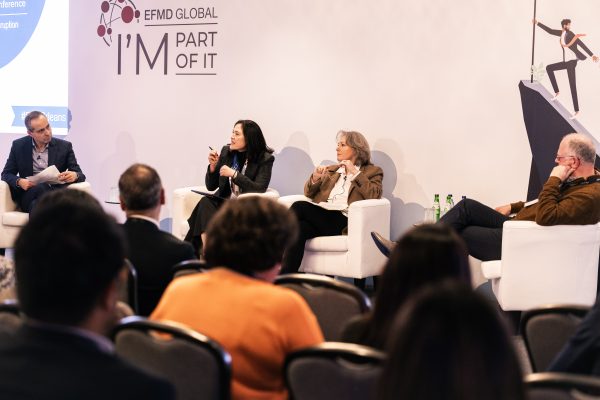
Later that afternoon, the second plenary shifted focus to the pressing realities of crisis leadership. Moderated by Matt Symonds, Editor in chief at BlueSky Thinking, the panel featuring Rachel Ashworth, Professor in Public Services Management & Former Dean at Cardiff Business School,, Yolande Chan, Dean and James McGill Professor at Desautels Faculty of Management, and Francisco Veloso, Dean of INSEAD. In a candid and thoughtful discussion under Chatham House rules, the panellist delved into the complexities of managing both internal and external crises.
-
Francisco Veloso, Yolande Chan, Rachel Ashworth, and Matt Symonds
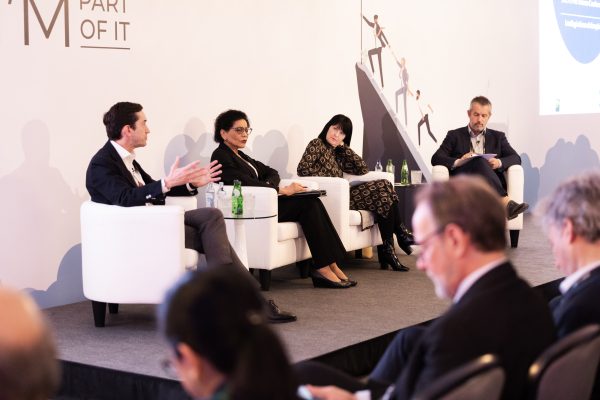
The day culminated beautifully across the street with a delightful gathering for drinks and dinner at Católica Lisbon School of Business and Economics, Universidade Católica Portuguesa.
-
Católica Lisbon School of Business and Economics, Universidade Católica Portuguesa

Embracing the future: AI and beyond
The second day began with a plenary session which explored how artificial intelligence is reshaping educational methodologies. In a discussion skilfully moderated by Joy Jones, CEO of the Graduate Management Admission Council, Isabelle Bajeux-Besnainou, Dean Tepper School of Business, Carnegie Mellon University, and David Bach, President of IMD, discussed real-world applications of AI in academic settings.
Bajeux-Besnainou observed that “if we don’t leverage these tools, we will become obsolete very quickly.” She pointed out that while professors are eager to adopt AI, many feel overwhelmed by the rapid pace of technological change, emphasising that the AI tools being developed for classroom use must be trained with pedagogical value in mind.
Speaking on ethics and AI, she noted that it’s worrying that STEM graduates are often the ones at the forefront of these important conversations.
“We need to insert a philosopher there to talk about ethics,” said Bajeux-Besnainou.
-
Joy Jones, David Bach and Isabelle Bajeux-Besnainou
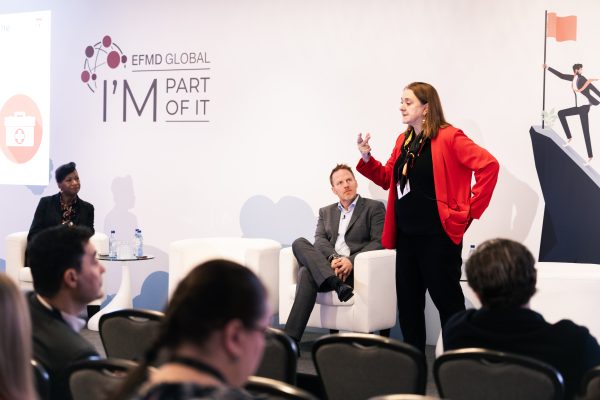
David Bach added that AI has the potential to revolutionise everything from course evaluations to personalised learning experiences, noting that the future of business education lies in integrating AI tools to enhance both teaching and learning outcomes. When asked if business education would ever become irrelevant in the face of new technology, Bach underscored that, to the contrary, it would be incredibly relevant.
“AI will not replace you– you’ll be replaced by people who know how to use AI better than you,” Bach said.
Bach noted that staying close to business is essential—not only to learn from it but also to provide guidance. Businesses are increasingly looking to faculty for direction, and in response, institutions are ensuring staff have access to the necessary tools.
-
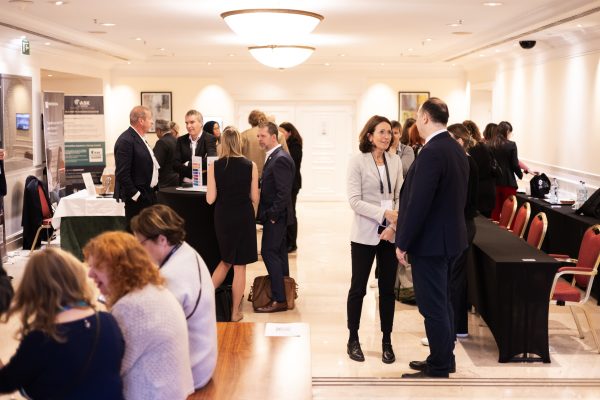
Networking at the 2025 EFMD Deans Conference, Lisbon
Breakout sessions: key discussions and insights
Throughout the afternoon, participants met for a series of dynamic discussions on some of the most pressing challenges facing institutions today. From fostering resilience in leadership and navigating the role of politics in academia to addressing the impact of geopolitical fragmentation and reimagining campus life, each interactive breakout session provided valuable perspectives and practical strategies.
Participants engaged in open dialogue, shared experiences, and explored actionable solutions to strengthen their institutions in an increasingly complex environment. These smaller, focused discussions allowed leaders to share best practices and explore innovative ideas in an intimate setting.
The session Building Resilience: An Open Discussion with Deans brought together business school leaders to explore strategies for fostering a positive institutional culture and addressing toxic behaviours. Nicola Kleyn, Extraordinary Professor at the Gordon Institute of Business Science, University of Pretoria, provided expert insights on resilience in leadership, emphasising the importance of clear values, open communication, and proactive intervention.
-
Building Resilience: An Open Discussion with Deans Himanshu Rai and Nicola Kleyn
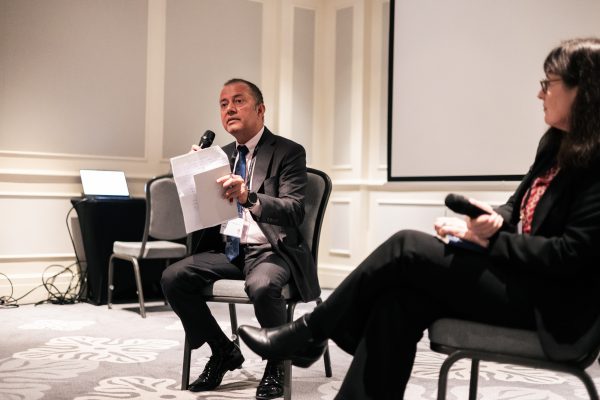
Moderated by Himanshu Rai, Director of the Indian Institute of Management Indore, the discussion encouraged deans to share experiences and best practices for navigating challenging environments. Participants left with practical tools to enhance their leadership approach and build more supportive, resilient academic communities.
The session Should Business Schools Be Political? sparked a thought-provoking discussion on the complexities of political engagement within academic institutions. Susan Christoffersen, Dean of the Rotman School of Management at the University of Toronto, and Leila Triki, Dean of the Mediterranean School of Business at South Mediterranean University, shared insights on the challenges deans face when navigating political discourse.
-
Should Business Schools Be Political: Martin Boehm, Susan Christoffersen and Leila Triki
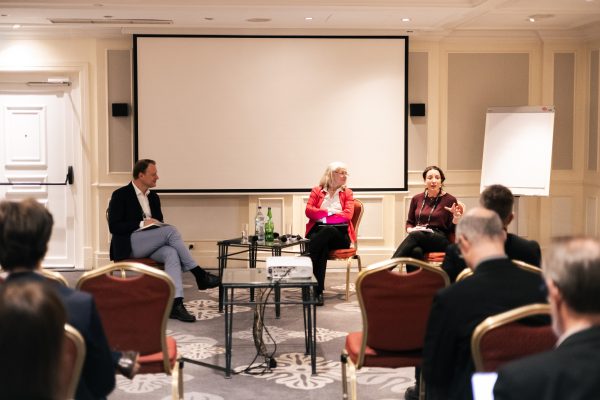
Moderated by Martin Boehm, Executive Vice President and Global Dean of Undergraduate Program at Hult International Business School, the conversation examined whether business school leaders should publicly take positions on political issues or uphold institutional neutrality. Participants explored the implications of both approaches, considering the evolving expectations of students, faculty, and society.
The session Bridging Borders: The Impact of Geographical Fragmentation on Business Schools and International Students examined the challenges of internationalisation in an era of geopolitical instability and shifting regulations. Jun Yang, Dean of Nanyang Business School at Nanyang Technological University, Frank Pons, Dean of Faculté des Sciences de l’Administration at Université Laval, and André Spicer, Executive Dean of Bayes Business School at City and St George’s University of London, shared real-world examples of how their institutions have adapted to these disruptions.
-
Bridging Borders: The Impact of Geographical Fragmentation on Business Schools and International Students: Frank Pons
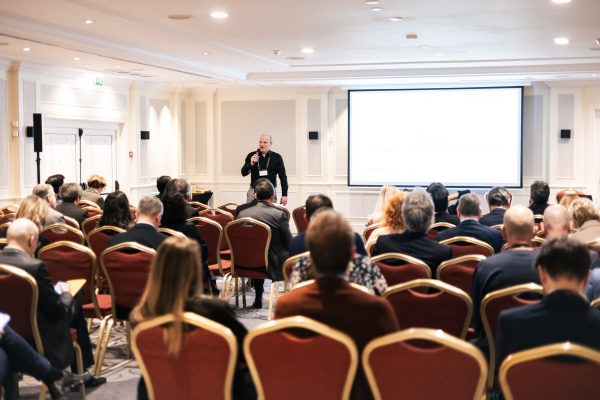
Another discussion, moderated by Delphine Manceau, Dean of NEOMA Business School, focused on strategies to enhance institutional resilience, maintain global engagement, and support international students amid an increasingly fragmented landscape.
The session Reimagining Campus Life: Strengthening Our Communities addressed the challenges and strategies for rebuilding vibrant, connected communities in business schools after the pandemic. Jordi Díaz, Dean of EADA Business School Barcelona, Gina Grandy, Dean & Professor at the University of Calgary’s Haskayne School of Business, and Arvind Sahay, Director of the Management Development Institute Gurgaon, shared innovative approaches to fostering engagement and a sense of belonging among faculty and staff.
-
Reimagining Campus Life: Strengthening Our Communities: Arvind Sahay, Gina Grandy, Jodi Diaz and Yolande Chan
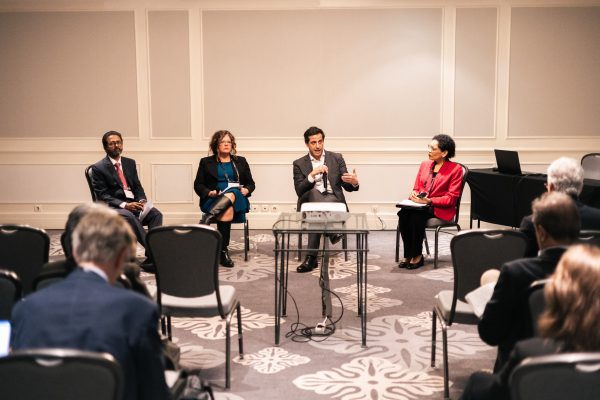
Moderated by Yolande Chan, Dean and James McGill Professor at McGill University’s Desautels Faculty of Management, the discussion explored methods such as physical re-engagement, virtual connections, and hybrid models to ensure community cohesion. Key takeaways included success stories from schools that have effectively adapted to the new academic environment.
The session The Rankings Debate: Value, Impact, and Inequality brought together key figures to explore the complex and often contentious role of business school rankings. Leila Guerra, Associate Provost for Lifelong Learning at Imperial College London, and Andrew Jack, Global Education Editor at the Financial Times, provided diverse perspectives on the subject. Moderated by Ines Drieselmann, Vice President of Alumni & Careers at IE University, the session covered the benefits and positive impacts of rankings and criticisms of current systems.
-
The Rankings Debate: Value, Impact, and Inequality: Leila Guerra, Andrew Jack and Ines Drieselmann
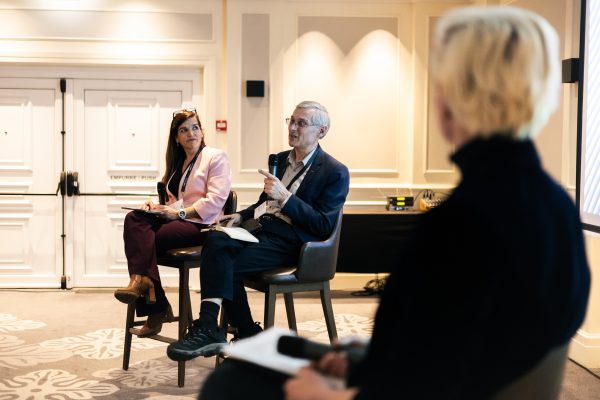
The discussion also tackled how ranking criteria can either perpetuate or help mitigate inequality among institutions. Participants gained a deeper understanding of the complexities surrounding rankings and their implications for business schools.
Moderated by Julia Bennell, Dean of Leeds University Business School at the University of Leeds, the Faculty Engagement: An Interactive Workshop provided deans with practical strategies for managing tenure faculty. Martin Boehm, Executive Vice President and Global Dean of Undergraduate Programs at Hult International Business School, Ann De Schepper, Dean of the Faculty of Business and Economics at the University of Antwerp, and Federico Pasin, Director at HEC Montreal, shared their experiences and best practices for tackling the complexities of faculty management.
-
Faculty Engagement: An Interactive Workshop: Julia Bennell, Federico Pasin, and Ann De Schepper
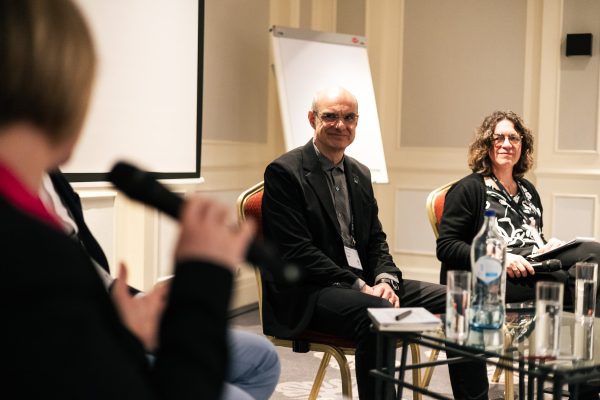
The session Rethinking the Business Schools of Tomorrow delved into the evolving demands and disruptions that business school leaders face in a VUCA (Volatile, Uncertain, Complex, Ambiguous) environment. Yusuf Sidani, Dean of the Suliman S. Olayan School of Business at the American University of Beirut, Karen Spens, President of BI Norwegian Business School, and Dominique Turpin, President (European) and professor of Marketing at CEIBS—China Europe International Business School, shared their perspectives on the future of business education.
-
Rethinking the Business Schools of Tomorrow: Karen Spens
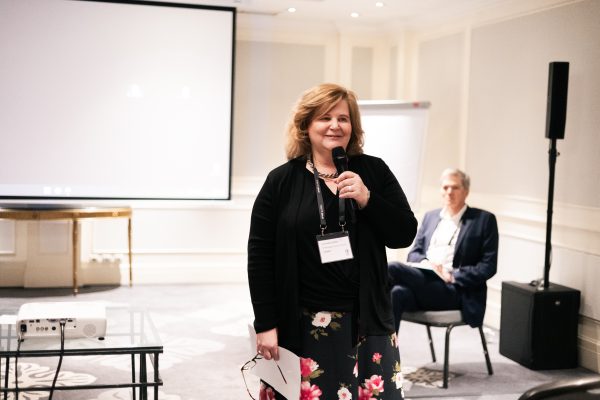
Moderated by Rupert Sausgruber, Rector of WU Vienna University of Economics and Business, the session explored the characteristics that business schools of tomorrow will, may, and should possess to remain relevant and future-proof in a rapidly changing world.
The session Impact Through Responsibility: Charting the Path for the Next-Generation of Business Schools focused on the evolving role of business schools in an era shaped by AI and societal expectations. Joakim Gullstrand, Dean of Lund University School of Economics and Management, Ulrich Thonemann, Dean of the University of Cologne’s Faculty of Management, Economics and Social Sciences, and Saonee Sarker, Richard E. Sorensen Chair & Dean of Virginia Tech’s Pamplin College of Business, explored the multifaceted nature of responsibility in business education.
The session addressed critical questions about how institutions can balance preparing the future workforce, conducting impactful research, and meeting the needs of industry partners and society. Participants worked through the process of determining which areas to prioritise, how to implement initiatives, and how to measure their success in shaping a responsible and future-ready business school.
-
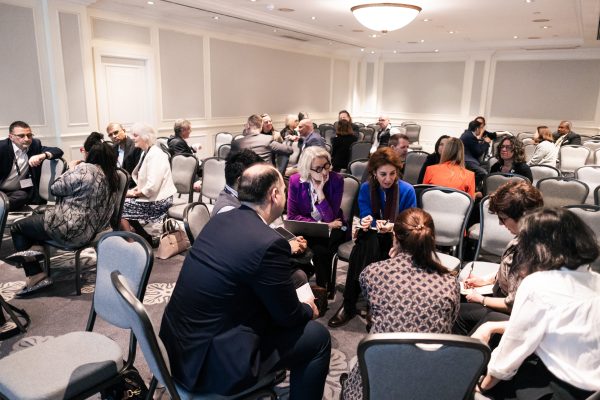
Day two Breakout Sessions: Participants engage in small group discussions
The future of learning in an era of chaos and complexity
The conference concluded with a futuristic plenary session, “Preparing for Future Disruptions,” where Tracey Follows, CEO of Futuremade and Visiting Professor of Digital Futures and Identity at Staffordshire University, shared insights on the technological and societal disruptions that business schools must address.
Moderated by Filipe Santos, Dean of the Católica Lisbon School of Business and Economics at Universidade Católica Portuguesa, the session explored the emerging trends and challenges that will shape the future of business education. Follows provided a comprehensive overview of the forces driving change. She spoke about chaos, complexity, and decentralisation, envisioning a future where learning might take place in virtual worlds.
In addressing the metaverse and the future of learning, Follows noted, “Future Business owners are learning on Roblox,” where biofeedback and VR could revolutionise emotional well-being.
Her insights challenged every attendee to consider not just the next steps for their institutions but the broader impact on society and the global economy.
Filipe Santos wrapped up the event with reflective closing remarks, emphasising the critical importance of values in leadership. He recalled that “one of the most important discussions we had is the fragmentation and nationalistic politics” and urged the deans to foster environments where innovation, transparency, and social responsibility are at the forefront.
-
Deans Conference Dinner at SUD Lisboa, 14 February 2025

As the conference drew to a close with a final dinner at SUD Lisboa, the sense of community from participants captured the event’s energy—a blend of inspiration, candid reflection, and an unyielding commitment to lead through disruption. Attendees mingled, networked, and shared reflections on the two days of intense dialogue and collaborative spirit.
-
SUD Lisboa

Concluding remarks
We extend our deepest gratitude to all who attended, including the speakers and steering committee members, for their contributions to making this event one of the most successful yet. We also express a special thank you to our strategic partner, the Graduate Management Admission Council (GMAC), and our gracious host, the Católica Lisbon School of Business and Economics at the Universidade Católica Portuguesa, whose support was instrumental.
We are immensely grateful for the exceptionally diverse and engaged EFMD business school leadership community, who once again came together to debate, envision, and chart a roadmap for impactful business education.
We are delighted to announce that the next EFMD Deans Conference will be hosted by the Vienna University of Economics and Business in Vienna, Austria, from 3 to 4 February 2026. We strive to keep the spirit high and eagerly anticipate welcoming you all next year, so please keep an eye on our events page for registration information and further updates.
A throwback of the live reactions from the 2025 Deans Conference is available on our X feed.
For additional insights, announcements and perspectives on Business School Leadership, visit the conversation here.


