

Sharing Best Practice: Daimler Truck’s structured approach to AI upskilling

On March 27, 30 corporate learning professionals from around the world joined the EFMD Sharing Best Practice online workshop in partnership with Daimler Truck.
Miriam Lozano Aviles, Head of Daimler Trucks’ Learning Academy, and Markus Rettich, Head of Global Leadership Programs, shared how their AI literacy campaign enabled the upskilling of more than 20,000 participants in AI tools such as M365 Copilot within just six months.
Rather than being driven by technology push or AI hype, the initiative was explicitly anchored in solving concrete business challenges—improving productivity, accelerating adoption, and ensuring safe and compliant use of AI. This ambitious effort has turbocharged productivity, elevated work quality, and embedded digital skills across the organisation. By providing clear guidance on responsible AI use, Daimler Truck has minimised the risks of inconsistent, non-compliant, or unsafe AI practices. In parallel, adoption increased significantly, with M365 Copilot Chat usage rising by more than 80% within six months.
The initiative applied a multi-channel activation approach, leveraging proven marketing mechanisms to drive engagement and participation at scale. It organised learners into peer groups to foster social learning, applied elements of gamification to increase engagement, and ensured accessibility by covering costs centrally and removing approval barriers. A variety of micro-learning formats and workshops were deployed, and role-specific sessions ensured that AI use cases were directly embedded in functional workflows. The roll-out followed a structured, phased approach across geographic and language zones, allowing for testing, refinement, and scaling.
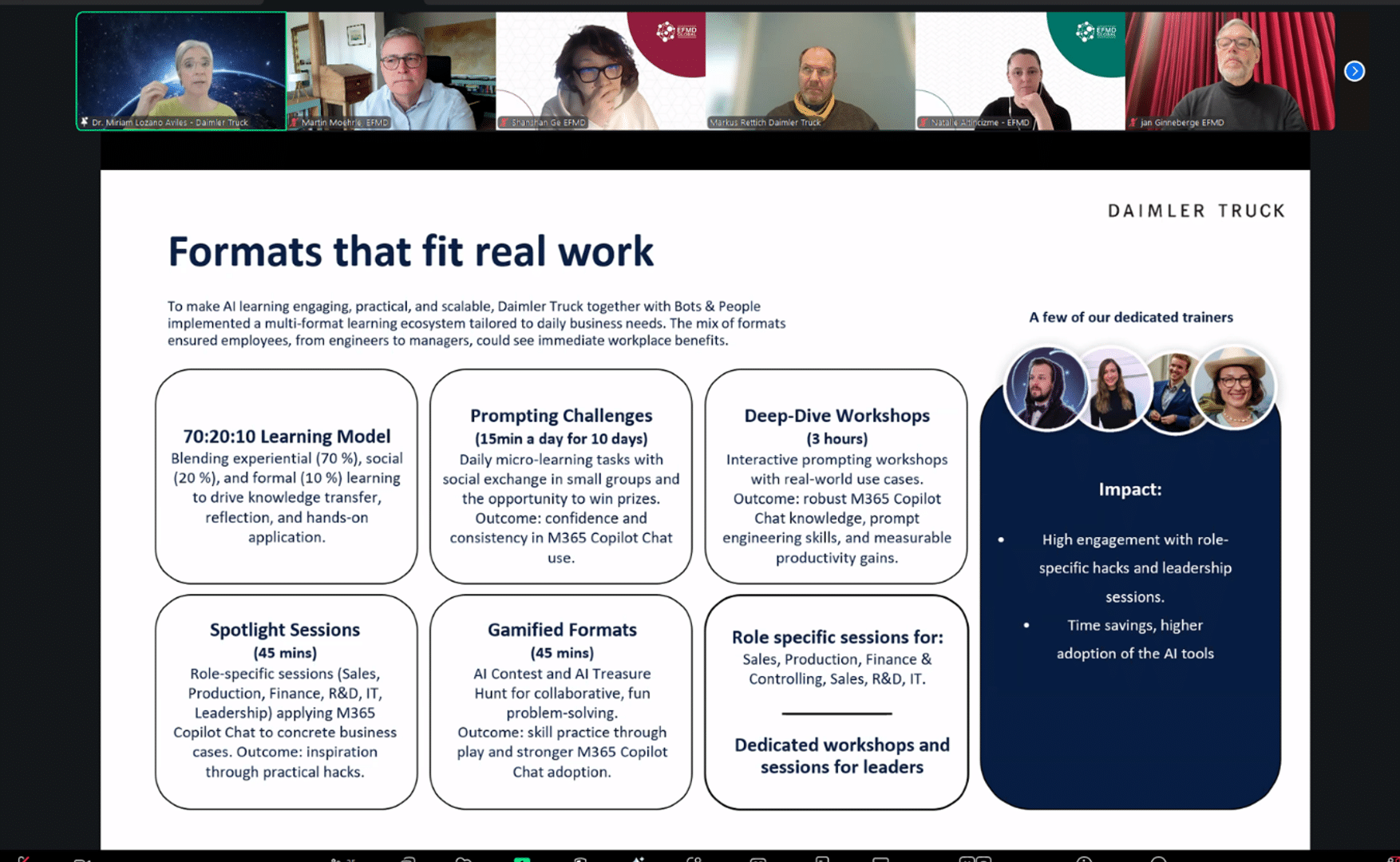
Throughout the workshop’s lively debate, it became clear that, as successful as this initiative has been, it represents only the beginning of a broader AI transformation journey that will likely extend over multiple years. The adoption of AI will have far-reaching implications for talent, culture, and organisational design. Among the most relevant emerging considerations are:
- An accelerated need for critical thinking and judgement at junior levels, as their traditional “playground” becomes increasingly automated
- The need to differentiate between acceptable and critical forms of skills atrophy, similar to earlier technological shifts, such as calculators or navigation systems
- The potential erosion of individual agency and ownership—and, by extension, experimentation and innovation—as AI agents become more deeply embedded into workflows
- The importance of sustaining human-centric leadership and a human-centric work environment
AI deployment is no longer optional. However, its impact on work systems is profound and multi-dimensional. Realising its full potential requires learning, talent, and organisational development functions to move beyond current AI hype and apply the full change and transformation toolkit.
Highlights and materials from this workshop (including the recording) are available in the Corporate Digital Library.
EFMD company members can request free access to this library if they have not yet done so. Guests from other companies can ask for temporary access by contacting Natalie Altincizme.
Save the date! Our next Sharing Best Practice Workshop for corporate members and invited guests will take place on 26 June 2026.

For additional insights, announcements and perspectives, visit the conversation on the Corporate Learning.


