

The hidden curriculum of climate anxiety: What business schools are missing about Gen Z learners
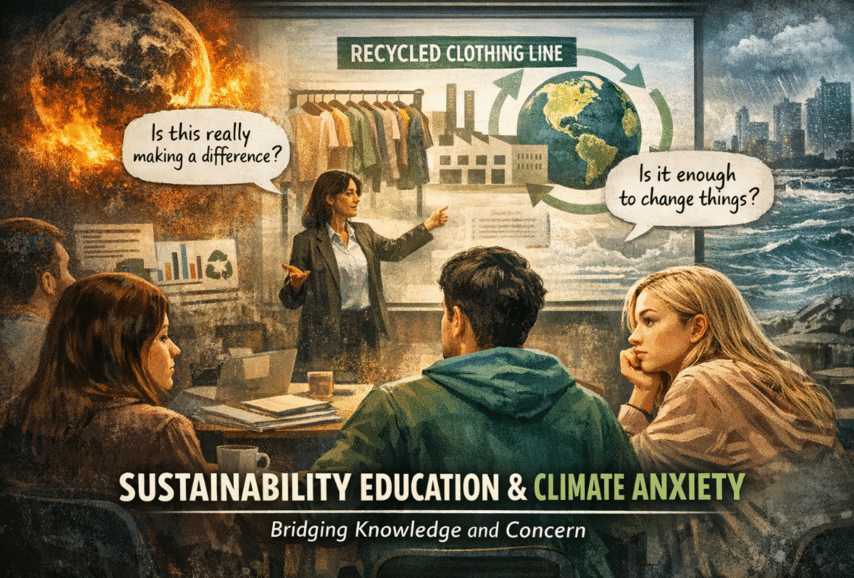
In a postgraduate marketing class discussing sustainable consumption, a case was presented on a multinational apparel company launching a recycled clothing line. The discussion began in familiar territory: lifecycle analysis, supply chain transparency, green pricing strategies, and reputational risk mitigation.
But midway through the session, the conversation shifted.
One student raised a question that moved beyond the case itself: “Even if companies do all this, are we actually solving anything at the scale required?” Another followed: “Is this just slowing down the damage rather than preventing it?” What began as an analysis of market-based sustainability strategies gradually evolved into a broader reflection on systemic inertia, corporate intent, and the limits of incremental change.
This was not a critique of the case or the pedagogy. It was an expression of something less visible but increasingly present in management classrooms: climate anxiety.
When sustainability education meets climate reality
Business schools have, in recent years, made commendable progress in embedding sustainability into their curricula. Courses on ESG metrics, climate finance, and responsible innovation now form part of mainstream management education. However, while institutions are equipping students with the analytical tools to address environmental challenges, many are overlooking the emotional and psychological context in which these tools are received—particularly by learners from Generation Z.
For today’s students, climate change is not an abstract policy issue or a long-term market risk. It is a defining feature of their anticipated futures. Reports of biodiversity loss, extreme weather events, and policy inaction are not distant headlines but part of their everyday information environment. As a result, sustainability education often intersects with a pre-existing sense of concern, frustration, or even helplessness about environmental decline.
In classroom settings, this can manifest in subtle but meaningful ways. Students may engage actively with sustainability frameworks yet remain sceptical about their real-world impact. They may demonstrate technical proficiency in carbon accounting or ethical sourcing while simultaneously questioning whether such interventions meaningfully alter systemic trajectories.
The hidden curriculum in action
Returning to the classroom example, the session concluded with students proposing alternative business models, including product-as-a-service systems and degrowth-oriented strategies. Yet, in post-class reflections, several expressed uncertainty about whether organisations would adopt such approaches in practice.
This gap between conceptual understanding and perceived feasibility reflects what might be described as a hidden curriculum. Alongside formal instruction on sustainability, students are informally learning about the constraints of institutional change, the pace of corporate transformation, and the tensions between profitability and planetary stewardship.
In effect, climate anxiety becomes an interpretive lens through which sustainability education is filtered. It shapes how students evaluate corporate initiatives, how they imagine their future roles as managers, and how willing they are to participate in existing economic systems.
Beyond competence: Fostering agency
Traditional models of management education often assume that increased awareness will translate into responsible action. However, the presence of climate anxiety complicates this assumption. Emotional responses such as fear or uncertainty can influence not only motivation but also perceptions of efficacy.
For many Gen Z learners, sustainability is closely tied to identity. Career aspirations, consumption practices, and entrepreneurial ambitions are increasingly informed by ethical and environmental considerations. Business education that focuses exclusively on technical competencies may therefore fail to engage with the identity-based drivers of sustainable behaviour.
Addressing this challenge does not require business schools to move beyond their educational remit. Rather, it involves recognising that learners’ emotional responses to global challenges are integral to the learning environment. Pedagogical approaches that incorporate experiential projects, stakeholder engagement, or future-oriented scenario planning can help students connect theoretical frameworks with tangible pathways for action.
In subsequent iterations of the marketing course, students were tasked with collaborating on sustainability audits for local enterprises. Engaging directly with implementation challenges allowed them to move from abstract critique to practical problem solving—transforming concern into constructive engagement.
Implications for business schools
Integrating an awareness of climate anxiety into sustainability education may have broader institutional implications. Programme design, faculty development, and impact assessment frameworks are typically oriented toward content delivery or alignment with global sustainability goals. Yet, evaluating educational effectiveness might also involve examining whether learners feel empowered to translate values into organisational practice.
As business schools seek to prepare graduates for leadership in an era of environmental uncertainty, attention to this hidden curriculum becomes increasingly important. Generation Z enters management programmes with a heightened awareness of planetary boundaries and a desire to align professional success with social responsibility. The task for institutions is not merely to inform these learners but to support their sense of agency within complex economic systems.
Looking ahead
The classroom discussion on recycled apparel was intended to illustrate market-based pathways toward sustainability. Instead, it revealed the layered realities that shape how such pathways are perceived by future managers.
Recognising climate anxiety as part of the learning context does not diminish the importance of analytical rigour. On the contrary, it highlights the need for pedagogical models that integrate knowledge with purpose—ensuring that sustainability education prepares graduates not only to understand environmental challenges but to act upon them with confidence and resilience.
For additional insights, announcements and perspectives, visit the conversation on Business Education.


