

Key takeaways from the 2025 EFMD Deans Conference by Chair Filipe Santos, Dean of Católica Lisbon School of Business and Economics
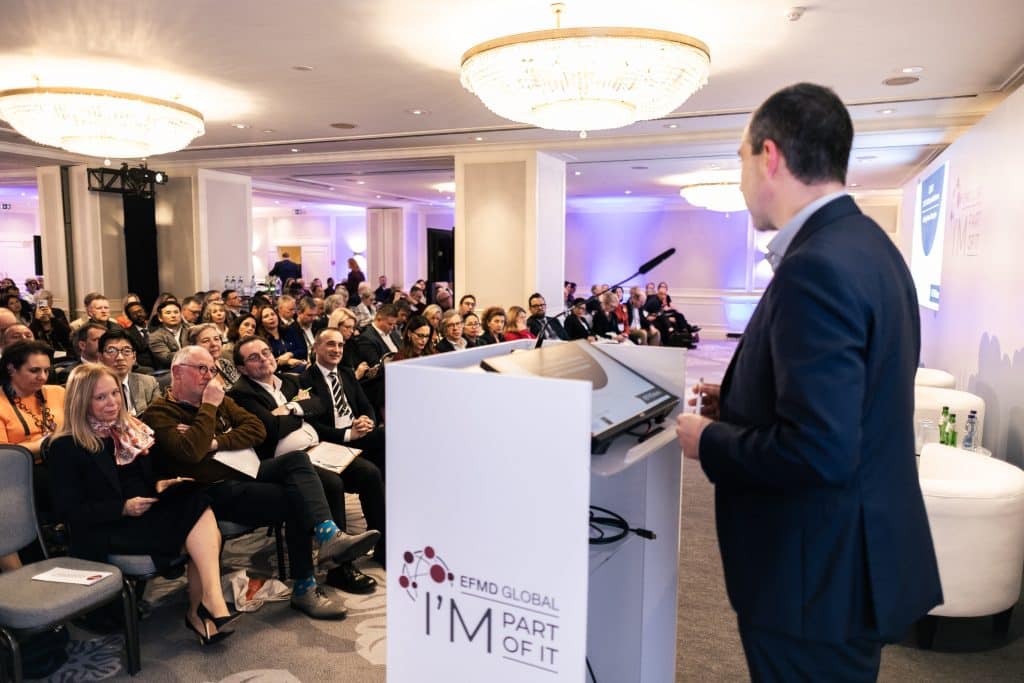
When the Programme Committee in mid-2024 chose the theme of the EFMD 2025 conference, “Leading in Times of Disruption”, we sensed but could not really imagine how much disruption would happen in the world in just a few months, with strong impacts on our business school sector.
I have been Dean of CATÓLICA-LISBON for 6 years and have lived through COVID, inflation crises and geo-political conflicts, but never before have I witnessed the level of global uncertainty, polarisation and fragmentation that we are now experiencing. This sentiment was shared by the 420 Deans who attended this year’s gathering, making it particularly lively, honest and reflective. This turned the EFMD 2025 Dean’s gathering in Lisbon, hosted by CATÓLICA-LISBON, into one of the most powerful and engaging conferences in a long time.
The Business School sector has grown immensely in the last 50 years as a result of deepening globalisation, with the rise of global corporations operating in a world with mostly free movement of people, goods, and ideas. There was also a dominant consensus in the last decade about the importance of sustainability, encapsulated in Environmental, Social and Governance dimensions. All that now seems put in question, changing the context for business schools structurally.
The context in which we live is one of profound polarisation, with cultural wars that infuse protests in University campuses and ideological extremism that has also transferred to politics, leading to increasingly populist and nationalistic government policies. We are also seeing the rise of conflicts across the world, particularly in Europe, the Middle East and Africa. The level of geo-political tension has been transferred to the economic realm as well, halting the process of globalisation, limiting the mobility of students and professionals, making ineffective the mechanisms for global coordination, and risking a steep increase in tariffs, leading to economic wars between nations and blocks.
For Deans of Business Schools and leaders of small but influential globalisation institutions who respond to multiple constituencies (from faculty to students, alumni, science, businesses, nations and ultimately, humanity and the planet that sustain us), this polarised and fragmenting world poses significant challenges of leadership.
In the opening session of the Conference, we had much food for thought, as the President of EFMD asked us to reflect on the role of business schools in this new context, the Rector of Universidade Católica highlighted the value of values in defining strategies, and the Mayor of Lisbon gave a lesson on public leadership, arguing that leadership is about intimacy and impact and that we should address the real and concrete problems of our constituencies with a focus on innovation, social welfare and culture.
Our keynote speaker, Steven Braekveledt, challenged us to think more deeply about the mission of business schools and the concrete results of our products and services. He also made a call for this gathering to have real impact. The Deans’ commentary that followed reflected on how the role of leaders is to absorb the complexity and have the wisdom to make difficult choices, craft the narratives that engage people, and develop concrete solutions adapted to specific contexts. Despite the challenges, business schools are in a unique position to have a meaningful impact on our education and research in an increasingly complex world.
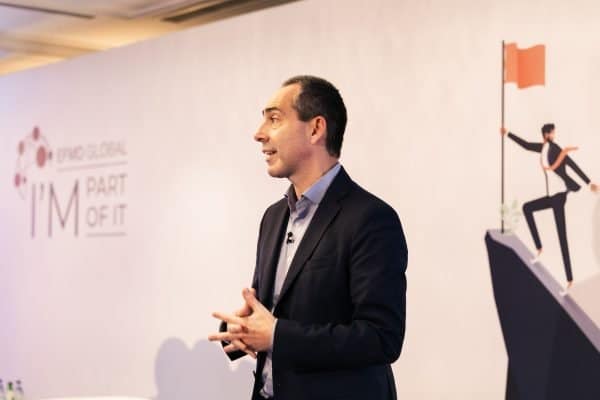
2025 EFMD Deans Conference Chair Filipe Santos, Dean of Católica Lisbon School of Business and Economics, sets the scene
The remaining of the conference, with engaged, honest and thoughtful sessions and debates, offered three deep areas of reflection about how to lead a business school in times of disruption:
How Political Should Business Schools Be?
In the current polarised environment where ideology reigns, it is hard to dissociate our personal beliefs from our duties as stewards of an important institution. But policy, not politics, is the realm of business schools. Business schools and their leaders should avoid getting mixed in political positions and ideological debates and, instead, aim to infuse in the discussion a level of scientific analysis and rationality that can make people understand the choices and compromises needed.
Our reputation and credibility come from being an informed and independent voice. That does not mean being neutral. It means being values-based and create a community where a space for “brave” debate is allowed and promoted, even about sensitive topics, as long as the debate is informed by evidence not ideology. In addition, staying true to our values makes it easier to discern when we should adopt intrusive government policies or rules or when we should apply some level of disagreement or symbolic compliance, always staying true to our beliefs.
How to deal with the AI Revolution?
The general sentiment shared at the conference was that the Generative AI revolution is transformational, and we either embrace it or will get disrupted. And the disruption will come slowly, slowly, then suddenly! Digital transformation is a huge opportunity for business schools to leverage generative AI, as it automates knowledge development, and Business Schools are essentially knowledge institutions.
In the universal value flow from data to information to knowledge to wisdom, we need to craft organisations that will be able to transform knowledge into wisdom instead of just information into knowledge. This value shift should inform the core transformation of our research and education activities while also deploying AI to improve our operations.
What is the Practice of Leadership for a Dean?
The VUCA world that we have been educating business leaders about for a decade now – a world with increasing volatility, uncertainty, complexity and ambiguity – has now arrived at an accelerated speed in the business school sector. In this world, the role of leadership is mostly a role of culture-building, developing a strong and resilient community with our key stakeholders, aligned by our values and guided by a sense of purpose.
As Business School leaders, we need to engage and connect as much as possible at a personal level and co-construct new solutions. Deans should also be aware that, in a VUCA world, crises will happen more frequently, and we need to anticipate them, developing contingency plans and rules of action. And it is in the midst of crises that we should be prepared to provide stronger and more directive leadership.
Overall, as leaders of Business Schools, we need to increasingly take care of the well-being of our community of faculty, staff, students, alumni, and the business leaders who depend on us for knowledge and wisdom. Our impact comes from empowering them to have meaningful careers and create value in their roles. As a final reminder about the conference, deans are not superheroes! Leading in a VUCA world is daunting, and we should allow our colleagues and team members to protect us and take care of our own well-being.
Welcome to the challenges of Leading in Times of Disruption!
Filipe Santos, Chaired Professor of Social Innovation, Dean of Católica Lisbon School of Business and Economics
For additional insights, announcements and perspectives on Business School Leadership, visit the conversation here.


