

Please mind the gap: Bridging ‘The Great Divide’ between business theory and practice in an increasingly digital environment

What type of educational experience can double the chances of participants running their own businesses after graduation? Find out more about the role of critically engaged experiential learning and explore strategies for maximising student engagement. Discover how these practices have the potential to close the gap and adapt to the rapidly developing digital landscape in higher education and industry.
Experiential learning builds in-depth knowledge through hands-on, real-world tasks. It requires critical reflection on concrete experience while building on theoretical underpinning, which contrasts with all too common passive consumption of course content (Kolb, 2015).
Young Enterprise has been operating for over 60 years in the UK and is partnered with JA Worldwide. In the Young Enterprise (YE) Start-up at Hertfordshire Business School (HBS), Graduate MBA students launch and operate actual businesses. A study spanning 50 years covering 371 YE alumni showed that those who participated were twice as likely to start their own businesses after graduation. Furthermore, 12% of those alumni were running businesses that turned over more than £500,000 per year versus 3% from non-alumni (Kingston University, 2012).
Despite these impressive results, relatively few business schools actively participate in this approach. Young Enterprise Start-up at HBS underscores the significant impact of experiential learning, inviting course designers to consider the balance between practice and theory and the transformational outcomes and stake.
Practice vs. research: Where is the balance?
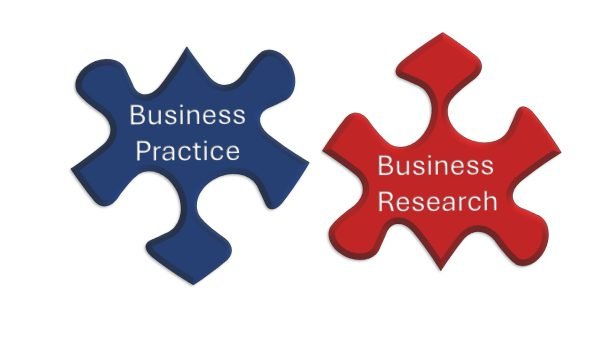
Practice and research are both essential, but arguably, they fulfil fundamentally distinct roles. The former involves much sought-after relevant business skills, whereas the latter focuses on the rigorous development of business theory. The Frascati definition of research emphasises a systematic approach, uncertain outcomes, generalisable knowledge, dissemination, and peer review (OECD, 2015).
Some commentators argue that in fields such as law, medicine, and engineering, theory and practice are intrinsically intertwined, with researchers and practitioners often viewing them as inherently interdependent (Skapinker, 2008, 2011). However, a surprisingly persistent and widening gap between the two has emerged in business education, referred to by some as a “great divide” (Dostaler & Toberlin, 2013).
Even though the relevance versus rigour dilemma persists, there is a possibility that it is a false dichotomy where priorities do not necessarily conflict. Left unchecked, this gap can lead to a worrying disengagement of students and a concerning disconnection with education’s major stakeholders and practitioners. The challenge from a programme design perspective in a pragmatic discipline like business is to achieve a balance between theory and practice and deny our students and practitioners the intrinsic importance of neither. How can this apparently elusive balance be achieved?
Disengaged vs critically engaged learning
Learning can become concerningly disengaged when theory lacks real-world application, making it difficult for students to connect course content with their practical activities. For example, part-time executive students often face challenges applying theoretical knowledge due to time constraints and other commitments. Consequently, studies from the Open University Business School (OUBS) indicate that disengaged learning, without strong links between new theories, critical thinking and new practice – much like “disengaged gears” – can lead to poor practical and educational outcomes.
According to Sheila Cameron’s MBA Handbook, this occurs when students have the knowledge to pass assignments (i.e. ‘shallow learning’) but little or no opportunity to put what has been ‘learned’ into practice (Cameron, 2020). This may well pass some assessments but simply defeats the wider objectives of education in a pragmatic discipline like business.
‘Critically engaged’ learning, according to Sheila Cameron’s MBA Handbook, emphasises problem-solving and theory application in real-world settings. This approach, as implemented in Young Enterprise Start-up at HBS, allows students to put theories to the test immediately in their own businesses. OUBS studies demonstrate better outcomes when theory, critical thinking, and practice are integrated – as with “fully engaged gears” (i.e. ‘in-depth learning’) (Cameron, 2020). So, if critically engaged learning is so important, how can a balanced approach to skills and knowledge in student engagement be achieved?
The importance of balancing skills and knowledge
Effective in-depth learning requires a fine balance between business skills (i.e. action) and knowledge (i.e. guidance for making business decisions). Kolb’s Experiential Learning Theory (ELT) prioritises the need to achieve a balance in a dynamic learning cycle (or spiral) across four dimensions, depending on the specific context in which the individual finds themselves:
- Experimentation: ‘Acting’ – Strong motivation for goal-oriented directed action that integrates people and tasks. (e.g. Critically analysing a marketing plan or top three business ideas with questionnaires, focus groups, pilot website, etc.)
- Reflection: ‘Reflecting’ – Ability to connect experience and ideas through sustained reflection. (e.g. Instigating regular team meetings to critically reflect on progress against a business plan or strategy and formulating plans to overcome challenges)
- Abstract conceptualisation: ‘Thinking’ – Ability to sustain disciplined involvement in abstract logical reasoning. (e.g. Conducting a break-even or discounted cashflow analysis to establish minimum sales to cover costs in the critical evaluation of a business plan).
- Concrete experience: ‘Experiencing’ – Ability to find meaning from deep involvement in the experience. (e.g. Conducting a brainstorming session for product development, attributes survey to analyse and assign roles to identify team members’ strengths or market testing a product or service)
(Adapted from Kessler, 2013)
HBS uniquely offers students the opportunity to integrate entrepreneurial skills (via Young Enterprise Start-up – Eight Milestones) with academic theory (via The Hertfordshire Graduate MBA – Six modules) across these dimensions. As these are real-world experiences (unlike other learning experiences such as simulations, roleplays, case studies, field trips, guest lectures, etc.), students even have the opportunity to develop strategic work experience to put toward professional qualifications. However, where opportunity is not enough, how can course designers further motivate students to integrate skills and knowledge effectively?
Leveraging mandatory assessments for engagement
Mandatory assessments drive student engagement in experiential activities like any other learning activity. When students know that experiential activities like Young Enterprise contribute to their grades, they engage more deeply and with greater commitment.
The Hertfordshire Graduate MBA programme actively incorporates experiential learning into the assessment framework of two out of six modules while clearly observing reduced engagement in YE activities that are not graded. If assessment drives engagement, how can course designers address the challenges of integrating theory and practice without perpetuating these issues in the expanding digital environment?
Experiential learning beyond borders
Leveraging experiential learning in a digital environment poses some unique challenges and opportunities. In 2024, the worldwide revenue for online learning markets was USD185Bn with an estimated 867 million users and is set to grow at around 9% through to 2028 (Statista, 2024a). An estimated 66% of the worldwide population is currently online (DataReportal, 2024), and the global spend on digital transformation is USD 2.5Tn (Statista, 2024b). To thrive in this increasingly competitive environment, the business education sector needs to focus on relevance as well as rigour.
According to Grant and Jordan, transnational companies use local resources to maintain high levels of responsiveness in their chosen locations (Grant & Jordan, 2015). This approach was once limited to large multinational corporations. Today, transnational microbusinesses offer global, cross-cultural learning opportunities. They blend local needs with global coordination, enabled by improved communication and collaboration technologies.
During the COVID-19 lockdowns, HBS hosted Young Enterprise Start-up operations online. Like others, they competed in the UK national finals digitally. With this potential of digital, experiential learning, how can digital experimentation drive programme development in this global context?
Digital experimentation: Real-world learning online
This article explored the transformative power of experiential learning through Hertfordshire Business School’s Young Enterprise Start-up programme. By combining hands-on experience with academic rigour, the programme enhances entrepreneurial knowledge and mindset.
Participants gain practical skills and confidence to address real-world business challenges. Key benefits include higher student engagement, better problem-solving abilities, stronger links between theory and practice, and a growing sense of identity as business leaders.
The article also tackled challenges like balancing theory with practice for students managing demanding academic workloads. It showed how this balance is achieved through mandatory assessments and fostering a critically engaged learning environment. Additionally, it highlighted the potential of digital platforms to broaden access and deepen engagement by supporting remote, global collaboration.
Now is the time to use digital tools to create transformative learning experiences. These tools can unlock new levels of engagement, improve access, and deliver life-changing outcomes through experiential programmes like Young Enterprise and JA Worldwide.
This blog is based on an EFTO presentation delivered during the EFMD Online Learning Symposium in Liverpool this past September.
References:
- Cameron, S. (2020). The MBA Handbook: Academic and Professional Skills for Mastering Management (9th ed.). Pearson Education, Limited
- Dostaler, I. and Tomberlin, T.J., 2013. The Great Divide between Business School Research and Business Practice. Canadian Journal of Higher Education, 43(1), pp.115-128.
- OECD (2015), Frascati Manual 2015: Guidelines for Collecting and Reporting Data on Research and Experimental Development, The Measurement of Scientific, Technological and Innovation Activities, OECD Publishing, Paris.
- Grant, R. M., & Jordan, J. (2015). Foundations of strategy (Second). Wiley.
- Kemp, S. (2024). Internet use in 2024. DataReportal. Available at: https://datareportal.com/reports/digital-2024-deep-dive-the-state-of-internet-adoption
- Kessler, E. H. (Howard). (2013). Encyclopedia of Management Theory. SAGE Publications
- Kingston University (2012). Classroom entrepreneurs almost twice as likely to run own business, study suggests. ScienceDaily.
- Kolb, D. A. (2015). Experiential Learning: Experience as the Source of Learning and Development (2nd ed.). Upper Saddle River, NJ: Pearson Education.
- Skapinker, M. (2008, November 15). Why business ignores the business schools. The Financial Times
- Skapinker, M. (2011, November 15). Why business still ignores business schools. The Financial Times
- Statista (2024a). Online University Education – Worldwide | Market Forecast. Available at: https://www.statista.com/outlook/dmo/eservices/online-education/online-university-education/worldwide
- Statista (2024b). Digital transformation spending worldwide 2017-2027. Available at: https://www.statista.com/statistics/870924/worldwide-digital-transformation-market-size/ [Accessed 26 Nov. 2024].
For additional insights, trends and perspectives about online education, visit the conversation here.


