

5 factors that make a good case study: Advice from an award-winning French-Hungarian teacher duo
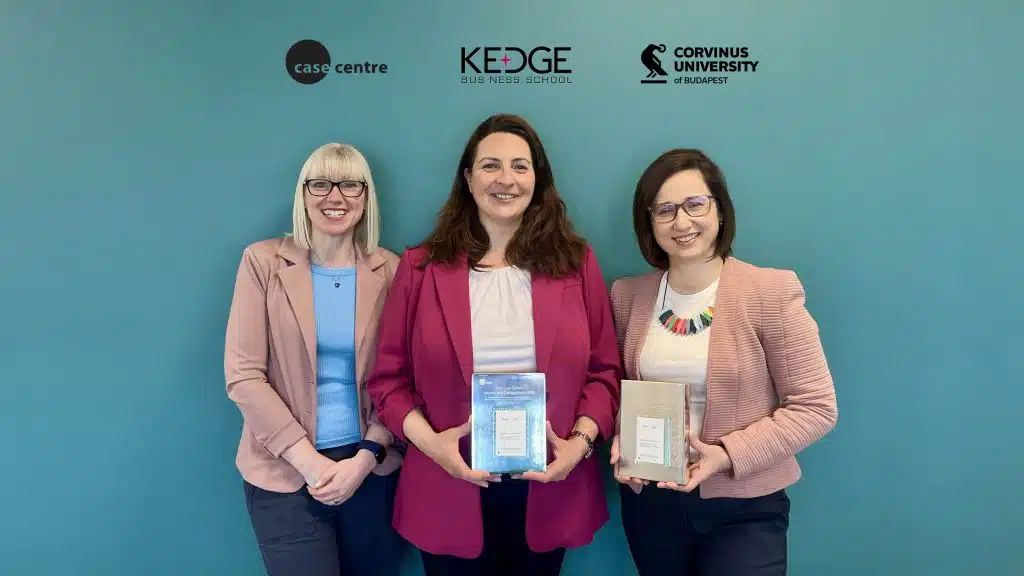
A well-written case study encourages students to think, weigh different options and make decisions in complex situations, say experts from Corvinus University and KEDGE Business School.
The joint case study by Dr Réka Franciska Vas, Associate Professor at Corvinus University of Budapest, and Isabelle Fagnot, Dean and Professor of Management Information Systems at KEDGE Business School, recently received international recognition. Their case was awarded in the Knowledge, Information and Communication Systems Management category at The Case Centre’s 36th Global Awards and Competitions, one of the most prestigious international competitions in case-based teaching.
The awarded case focuses on data management challenges related to higher education accreditation. It examines why it is often difficult to produce reliable reports even when the necessary data appears to be available. This may seem like a technical issue, but it is closely connected to organisational processes, responsibilities, decision-making and institutional culture.
The EFMD connection
The collaboration between Réka and Isabelle began through EFMD. They met at an EFMD data management training course, where they quickly realised that they had similar professional interests and experience. Both were interested in how higher education institutions collect and use data for accreditation, reporting and decision-making.
Isabelle now teaches the case in one of the most successful EFMD training courses, the Smart Data Management. At Corvinus, Réka mainly uses the case in master’s programmes, including AI in Business, Digital Innovation and Social Data Science.
Built on real experience
According to the authors, the most important features of a strong case study are:
- It is based on real experience. Réka and Isabelle chose a problem they were well acquainted with from their own professional environments. It starts from a real and recognisable problem.
- It is not too long, ideally only a few pages, but it is complex enough to make students think.
- Fine-tuning the opening situation is crucial.
- It presents several actors and perspectives (dialogue can work for it), and it does not suggest a single correct answer.
- It allows students to connect knowledge from different fields.
In their view, a case works best when students cannot immediately say, “This is obviously the solution”. A good case creates uncertainty, but not confusion. It places students in a decision-making situation in which they must consider different interests, consequences, and possible outcomes.
Creating the “aha” moment
When solving, students cannot simply repeat theory; they have to apply it. They may know, for example, what data governance means in theory, but in a specific organisational situation, they also need to think about responsibilities, processes and decisions. This makes the case-based teaching particularly valuable.
Réka especially values those moments when students draw on knowledge from another course. These moments are particularly insightful because they show how the same problem can be approached from many different perspectives, while also highlighting opportunities in the curriculum where closer collaboration and stronger alignment between different courses and their instructors could be further developed.
Finding the right opening situation was crucial when writing the case. Réka and Isabelle spent considerable time identifying an example that was credible, engaging and not too specific to one institution. This way, it could work not only in higher education, but also in broader organisational and business contexts.
Small and medium-sized enterprises, for example, often face similar challenges when they want to become more data-driven but do not yet have the necessary structures, responsibilities or processes in place.
The lecturer’s role
The authors also emphasise that a case study is not, in itself, a miracle solution. Its success depends heavily on the lecturer, whose role is not to provide ready-made answers, but to guide the discussion with good questions. They must help students move forward when they get stuck and encourage them to examine the situation from different perspectives.
The joint authorship also played an important role in the case’s success. Réka and Isabelle continuously reflected on each other’s ideas, tested the narrative and brought in new perspectives. This was especially useful because the case needed to work in different countries, teaching environments and participant groups.
A good case study is therefore much more than a well-written story. It is a carefully constructed learning situation that must be credible, focused and open at the same time. Based on the shared experience of Corvinus and KEDGE, a strong case does not tell students what to think. It helps them learn how to think in a complex, responsible and independent way. It is also rewarding for lecturers, because students often bring in ideas and interpretations that even the authors had not originally considered.
Illustration caption: Vicky Lester, CEO of The Case Centre, Isabelle Fagnot, Dean and Professor of Management Information Systems at KEDGE Business School and Dr Réka Franciska Vas, Associate Professor at Corvinus University of Budapest
Credit: The Case Centre/Corvinus
For additional insights, trends and perspectives, visit the conversation on the Case Method.


