

The MBA at a crossroads: Why human skills matter more than ever in the age of AI
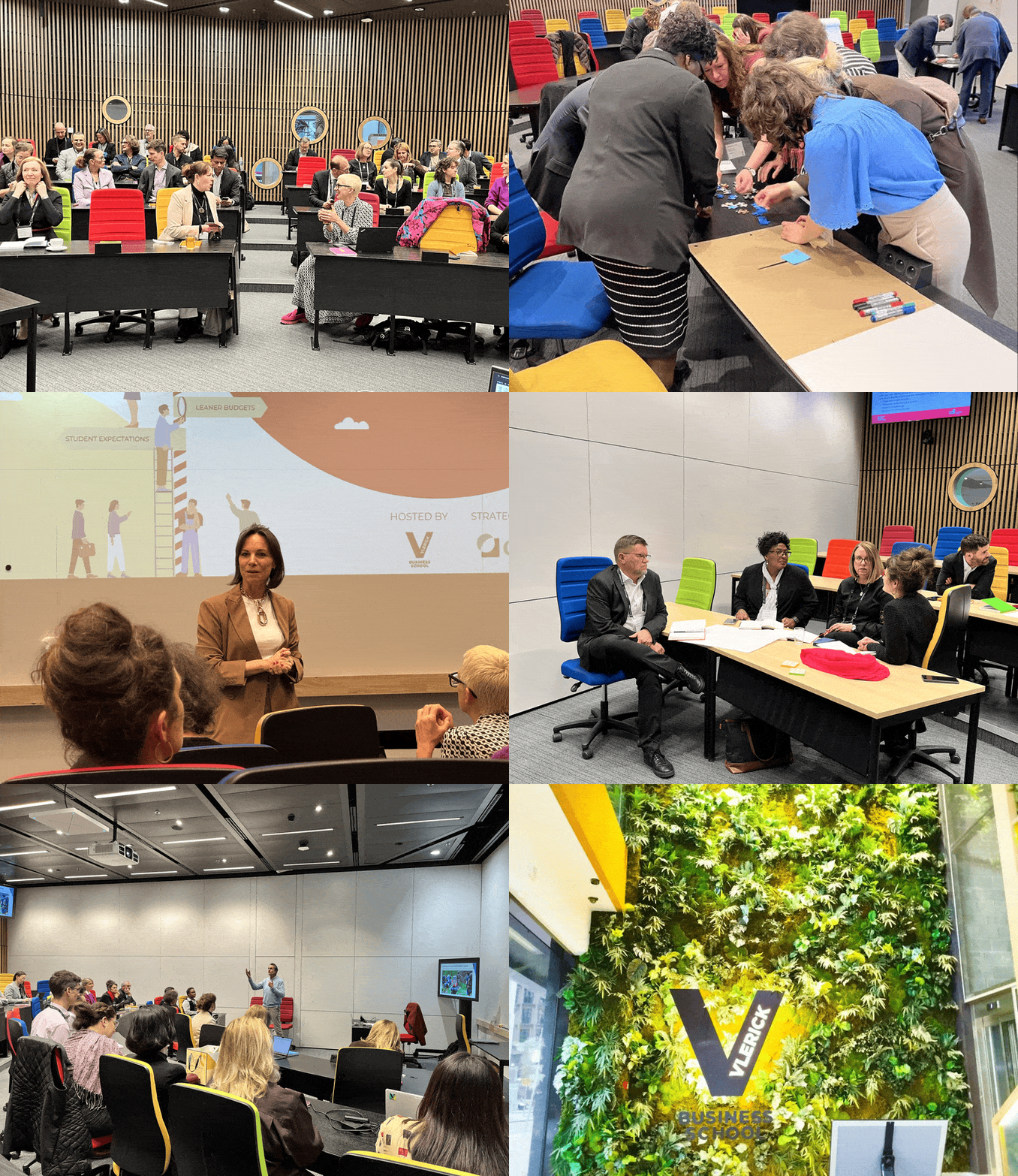
I recently attended the 2026 EFMD MBA Conference at Vlerick Business School in Brussels, a gathering that brought together MBA directors, programme leaders, and institutional decision-makers from across the sector.
The MBA has long held a central place in management education, often serving as both a signal of institutional quality and a driver of reputation. Yet throughout the conference, it became increasingly clear that this position can no longer be taken for granted. The MBA is not in decline, but it is under scrutiny, and expectations from students, employers, and society are shifting in ways that require a more deliberate response.
Across two days of discussion, debate, and reflection, a number of themes emerged. While each session approached the future of the MBA from a different angle, together they formed a coherent picture: business education is entering a period of structural adjustment. What follows is a synthesis of the sessions that stood out most, interwoven with my own reflections on what they signal for the future of MBA programmes.
The MBA at a crossroads
The opening plenary, led by Nick van Dam, established the central tension running through the conference. For more than a century, the MBA has been the defining qualification for aspiring business leaders. Today, however, that position is being tested by technological change, shifting labour markets, and evolving expectations of leadership.
Artificial intelligence sits at the centre of this shift. As van Dam argued, we are moving into a phase where machines increasingly take on tasks that were once considered the preserve of highly educated professionals. These include:
- Pattern recognition and data processing
- Structured problem-solving
- Prediction based on historical data
- Elements of operational and analytical decision-making
This is not a distant prospect. It is already visible in sectors ranging from consulting to law, finance, and software development.
What is changing, therefore, is not simply how work is done, but how value is defined. If machines can perform cognitive tasks with increasing efficiency, then the differentiating contribution of humans must lie elsewhere. This reframing moves the discussion beyond whether AI is a threat. Instead, it forces a more precise question: what remains uniquely human in professional contexts?
Van Dam’s answer centres on a set of capabilities that resist automation. These include instinct, intuition, imagination, integrity, and identity. While these qualities are often discussed in abstract terms, the argument here was more grounded. They are not peripheral attributes. They are becoming central to leadership effectiveness in environments where data is abundant but meaning is contested.
The notion of a “Human Intelligence Quotient” provides a useful way to conceptualise this shift. It suggests that human capability is not simply a complement to technical skill, but a distinct domain that must be developed with equal rigour. This has direct implications for MBA design.
One of the more compelling aspects of the session was the insistence that incremental change is insufficient. The MBA cannot respond to AI by adding isolated modules or elective courses. Instead, it requires a structural redesign built around four interdependent elements:
- AI literacy is embedded across all disciplines
- Depth within a chosen field of expertise
- A mindset oriented toward continuous learning
- Deliberate development of human leadership capabilities
Without that integration, the MBA risks preparing graduates for a work model that is already being redefined.
Ecosystems as a competitive advantage
The session “Leveraging your ecosystem,” facilitated by Rebecca Loades and featuring Veroniek Collewaert, Chahndra Dal Pont, Silvia McCallister-Castillo, and Leon Gazet Du Chattelier, shifted the discussion from internal design to external positioning. The central argument was that MBA programmes can no longer differentiate solely through their curricula.
Instead, competitive advantage increasingly depends on how effectively a programme is embedded within its broader environment. This includes relationships with employers, regional industries, public institutions, alumni networks, and other educational providers. These connections are not supplementary. They are integral to the creation and delivery of value.
What was particularly notable was the emphasis on specificity. Rather than adopting generic strategies, institutions are encouraged to develop a detailed understanding of their own operating environment. This includes identifying the needs of local employers, the characteristics of the regional economy, and prospective students’ expectations.
Several practical principles emerged from the discussion:
- Technology should follow strategy, not define it
- Local relevance is a prerequisite for global reach
- Collaboration can be more effective than direct competition
- Ecosystems must be built on clear, mutual value
Silvia McCallister-Castillo illustrated this through her engagement with local chambers of commerce, creating direct pathways between students and employers. Chahndra Dal Pont emphasised the importance of returning to institutional strengths, while Leon Gazet Du Chattelier emphasised the need to understand stakeholder incentives.
Taken together, these perspectives suggest that ecosystems function as strategic infrastructure rather than optional extensions. When developed intentionally, they expand what an MBA programme can offer far beyond the classroom.
Building institutions that learn
In the session “To know what works in education, build institutions that learn,” Tijana Prokic-Breuer introduced a more critical perspective on how innovation is approached within education.
Her argument focused on three recurring patterns that limit the effectiveness of institutional change:
- Innovation without evidence
- Evidence without implementation
- Implementation without learning
These patterns are familiar, yet they persist across the sector. What makes them particularly problematic is that they create the appearance of progress without necessarily improving outcomes.
A key contribution of this session was the challenge to reconsider what constitutes evidence. In many cases, institutions rely on documentation, metrics, and testimonials that demonstrate activity rather than impact. The distinction between the two is significant. Activity can be measured relatively easily. Impact requires more rigorous evaluation.
The proposed alternative is to treat institutions as learning systems. This involves adopting structured approaches to problem definition, intervention design, implementation support, and impact evaluation. The 5D model referenced in the session provides one framework for this process, emphasising the importance of moving deliberately through each stage rather than rushing from idea to execution.
For MBA programmes, this raises important questions. If business schools aim to develop leaders capable of evidence-based decision-making, then they must apply the same standards to their own operations. This includes being transparent about what works, what does not, and why.
Leadership lessons from nature
The session “Leadership lessons from nature,” led by Barney Jordaan, offered a markedly different perspective on leadership development. Rather than focusing on frameworks or models, it presented a programme built around immersion in a natural environment.
Participants in this course are removed from familiar settings and placed in conditions that require heightened awareness and adaptability. Without the usual structures of organisational life, individuals are confronted with their own behavioural patterns more directly.
Observations drawn from nature become prompts for reflection. For example, the session highlighted how different species approach conflict and leadership:
- Hyenas engage in conflict but quickly re-establish social bonds
- Giraffes may clash physically, then return to shared resources
- Elephants follow leadership grounded in trust rather than dominance
- Wild dogs reinforce cohesion through collective rituals
The emphasis is not on romanticising nature, but on using it to question entrenched assumptions about leadership. Conflict, authority, and cooperation are reframed as dynamic processes rather than fixed states.
One of the more striking aspects of the session was its focus on presence. Activities such as night watch, where participants spend extended periods alone in silence, create space for reflection that is difficult to replicate in conventional programmes.
While this approach may not be scalable in a traditional sense, it raises a valuable question about the role of experience in management education. To what extent can classroom-based learning capture the complexity of real-world leadership? And what might be gained by incorporating more immersive elements into MBA design?
Educating rebels with a cause
The session “Educating rebels with a cause: rethinking the purpose of business education” addressed the broader aims of MBA programmes. The concept of the “rebel” was reframed as someone willing to question assumptions and act when existing systems are no longer effective.
Research presented in the session highlighted a gap between expectations and experiences. Students often enter programmes seeking:
- Validation of their knowledge through structured frameworks
- Career acceleration and progression
- Networks that expand professional opportunities
What they frequently report gaining, however, extends further:
- Increased self-awareness and reflection
- A stronger sense of purpose and direction
- Greater confidence in leadership identity
This leads to the idea of the MBA as an “identity workspace.” In this view, programmes are not only sites of knowledge transfer but also spaces where individuals reconsider how they see themselves and their role in the world.
Designing programmes to support this process requires intentionality. It involves creating environments where values-based discussions can take place, where students feel able to question established norms, and where real-world engagement is integrated into the curriculum.
At the same time, there are constraints. Rankings systems, financial pressures, and labour market expectations all influence programme design. The challenge is to navigate these constraints without losing sight of broader objectives.
Capital, technology, and the workforce
The session “Education, capital, and the workforce: what we should be watching now” examined the external forces shaping the education sector. A key theme was the shift in investment patterns within EdTech and related areas.
While overall investment levels have declined from previous peaks, this is better understood as a recalibration rather than a contraction. Investors are adopting longer time horizons and placing greater emphasis on measurable outcomes. This has implications for both startups and established institutions.
For business schools, the message is clear. Value propositions must be articulated with greater precision. It is no longer sufficient to rely on brand or tradition. Programmes must demonstrate how they contribute to employability, skill development, and long-term career outcomes.
Several priorities emerged for institutions navigating this shift:
- Align programmes with workforce needs and measurable outcomes
- Engage directly with students to understand expectations
- Monitor investment and innovation trends within education
- Reconsider partnerships and delivery models in light of global shifts
Technology plays a central role in this transition, influencing both how education is delivered and how work itself is structured. At the same time, geographic mobility patterns are changing, with more students choosing to study within their home regions.
What the data tells us
The session “Global management education trends: what the data tells us about 2025 and beyond,” presented by Sara Strafino, provided a data-driven perspective on many of the issues discussed throughout the conference.
Application trends indicate a gradual decline in demand for traditional MBA programmes, even as interest in specialised master’s degrees grows. Preferences are also becoming more varied, with increasing demand for flexible and hybrid formats.
Key trends highlighted in the data include:
- Declining intention among candidates to pursue traditional MBAs
- Growth in specialised business master’s programmes
- Rising demand for hybrid and flexible delivery formats
- Increased importance of digital and AI-related skills
External factors, including visa policies, continue to influence student mobility, while employer expectations reinforce the importance of both technical competence and human skills.
This supports a broader conclusion that emerged repeatedly across the conference. The future of management education lies not in choosing between technical and human capabilities, but in integrating them in a way that reflects real-world complexity.
Final reflection
Throughout the conference, there was a clear recognition that the MBA remains a valuable qualification. However, its value is no longer assumed. It must be actively demonstrated through programme design, delivery, and outcomes.
What stands out is the scale of the changes being discussed. This is not a matter of incremental adjustment. It is a reconsideration of core assumptions about what the MBA is for and how it should function.
For me, the most significant shift is in emphasis. The conversation is moving away from content and toward capability, from structure and toward experience, and from individual programmes toward broader systems.
The MBA will continue to play an important role in management education. The question is not whether it will endure, but in what form. Those programmes that succeed are likely to articulate their purpose clearly, adapt to changing conditions, and remain grounded in the needs of the individuals and organisations they serve.
This is a demanding standard. It requires institutions to be both reflective and responsive. Yet it also presents an opportunity to redefine what management education can achieve.
In that sense, the MBA is not at risk of becoming irrelevant. It is being asked to become more precise, more accountable, and more aligned with the realities of the world it seeks to serve.
Professor Naomi Birdthistle is the MBA Director at Griffith University, Gold Coast Campus in Australia.
For additional insights, trends and perspectives on the EFMD MBA Conference, visit the conversation on MBA Programmes in Business Education.


