From promise to practice: AI and the future of executive development
When we began planning the 2026 EFMD Executive Development Conference at UCD Smurfit Executive Development, our ambition was to move beyond the rhetoric surrounding AI and explore what is happening in practice.
For executive educators, two questions matter: how is AI changing the organisations we serve and the capabilities their leaders need? And how might it transform the way we design and deliver executive development?
Two developments stood out immediately.
The extraordinary pace of change, and AI’s potential as a force for good. Our opening discussion brought together perspectives from Irish AI startup Jentic, Microsoft, Novartis and CeADAR, Ireland’s national centre for applied AI. The breadth of change was clear in the UCD AI ecosystem sessions, where applications in healthcare, weather and climate, agentic commerce and AI governance demonstrated that this is already happening in the real world.
Equally striking was the speed with which learning and talent leaders are adapting. Our panel on the future of learning and skills, alongside the EFMD Excellence in Practice Award cases, showed how organisations and business schools are experimenting, partnering and responding to new demands. We also explored AI-enabled approaches to executive development, including a capability development tool we are piloting with our client Bord Bia. The key is knowing where these tools actually improve learning.
Perhaps my strongest reflections, however, came from two conversations that challenged us to look beyond the technology.
David McCourt offered a provocative perspective on the evolution of capitalism, particularly the increasingly extractive focus on maximising shareholder returns. His challenge was whether AI would simply accelerate that model, driving ever greater efficiencies, or whether we could use it to create broader value for employees, customers and communities. For those of us engaged in developing leaders, this raises important questions about the values underpinning our work and the kind of leadership we seek to encourage.
Mark Little reminded us that AI is not human. It cannot experience love, grief or joy, however persuasively it may simulate interaction. Yet it can sharpen our thinking, for example, through a ‘pre-mortem’ that tests assumptions before decisions are made. I was especially struck by his call to move from an ‘age of attention’ to an ‘age of intention’. Big tech algorithms have quietly shaped what we see and consume, often before we fully understand their influence. Now, with greater awareness, we have a chance to make more deliberate choices about how technology shapes our lives, work and future.
For me, that captures the conference’s central question: not just what AI can do, but what we want it to do, and why. As knowledge becomes more readily available, executive education must increasingly help leaders think critically, challenge assumptions and exercise judgement amid uncertainty. Our job is to help leaders make decisions rooted in human values and purpose.
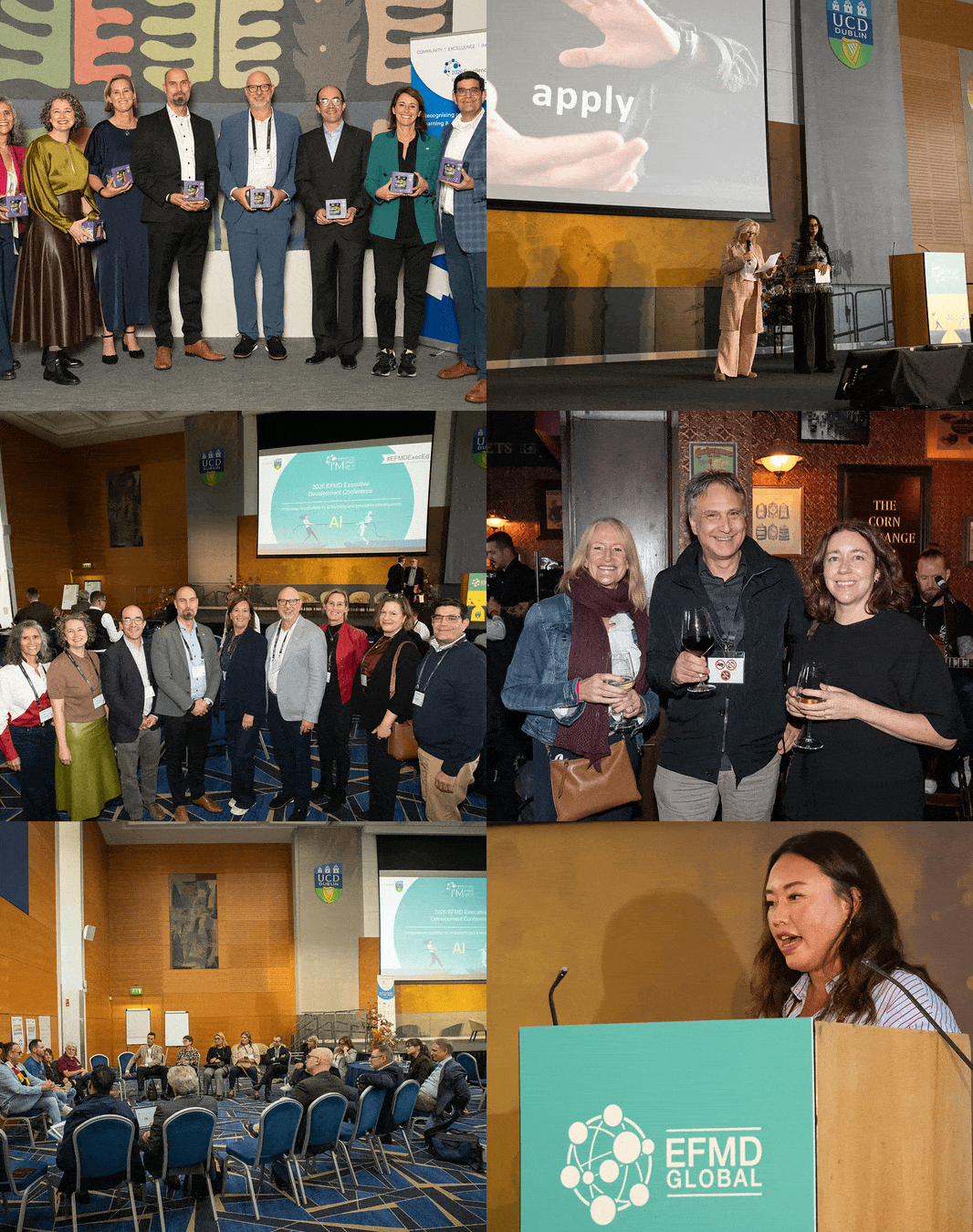
Beyond the sessions, the openness of the conversations and connections across our global community was a real highlight. From an evening of Irish music in Dublin to the Excellence in Practice Awards Gala Dinner at the UCD University Club, the sense of collegiality was wonderful. Talented UCD student musicians brought the house down with their traditional Irish music, a memorable finale to two inspiring days.
My thanks to EFMD, our speakers, contributors and delegates. We left with new ideas, valuable connections and better questions about the future we want to create.
Tim Wray is the Director of UCD Smurfit Executive Development.
For additional insights, announcements, and perspectives, visit the conversation on Business Education.