

How JLL Academy Ensures Learning Delivers Impact: Company Perspective
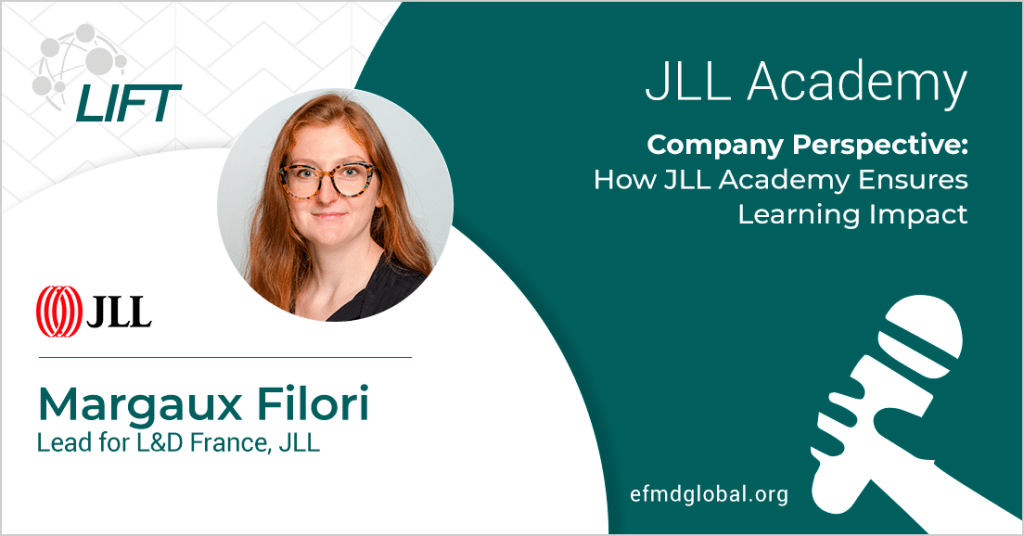
This blog series provides a comprehensive look at the LIFT certification process from two critical perspectives: the peer reviewers who evaluate and endorse the certification and the company that has successfully achieved it. Through firsthand insights, we will uncover how LIFT-certified learning functions embedded impactful learning into their organisational framework and the benefits that ensued.
JLL is a global real estate services firm specialising in commercial property and investment management, providing services for real estate owners, occupiers and investors worldwide. Leading the way on sustainability is fundamental to JLL’s purpose to shape the future of real estate for a better world. By developing organisational core competencies in sustainability, technology and innovation, JLL Academy’s ultimate goal is to establish JLL as a trendsetter and influencer in professional education in the real estate sector.
The Academy achieved the LIFT Certification in September 2023 being praised for its commitment to measuring impact through strong stakeholder involvement, alignment to JLL France’s strategic goals, robust measurement, and a disciplined approach, as highlighted by Achim Wolter of the Bâloise Group and a member of its peer review team.
Margaux Filori, the Head of JLL France Academy, shares insights into their LIFT journey:
What were your motivations for going through the LIFT certification?
Our decision to pursue the LIFT certification from EFMD was driven by several key motivations.
Most importantly, this certification allows us to position impact as a central measure in our L&D strategy. It provides a framework and evaluation method to measure the impact of our training initiatives, which is crucial in demonstrating the added value of the L&D function to the business. This approach encourages us to consider impact from the very beginning of any programme or initiative, rather than as an afterthought.
The international reputation of EFMD’s quality label was another significant factor. It aligns with JLL’s L&D objective to meet the highest academic standards, both in terms of learning methods and formats, as well as the subjects we explore and the skills we aim to develop. This certification proves and internationally validates our commitment to excellence.
Moreover, the LIFT certification recognises the quality of our training and the investment and engagement of our employees, internal trainers, and management team. It showcases our ambition to strive for excellence and helps the business understand the value and impact of our training programmes on the company’s performance.
What benefits did you perceive through conducting a self-assessment on how you were currently approaching learning impact?
Engaging in a self-assessment of our learning impact as part of the LIFT certification process proved to be extremely valuable for our team. It has been instrumental in elevating our approach to learning impact, making it more strategic, structured, and aligned with our organisational objectives.
It allowed us to position impact at the forefront of our learning and development strategy. This shift in perspective encouraged us to consider impact from the very beginning of our training development process, rather than as an afterthought. By doing so, we were able to create a framework that enables us to measure the impact of our training programmes more effectively.
The self-assessment process also prompted us to construct a comprehensive framework around impact measurement. We explored existing impact measurement frameworks and critically evaluated how we could apply them within our organisation. This exercise helped us transform our implicit processes into explicit frameworks, providing a more structured approach to assessing learning impact.
Moreover, the self-assessment served as a thorough evaluation of our existing learning capabilities and ways of working. It allowed us to identify our strengths that could be reinforced and potential weaknesses that needed addressing. This introspective process was invaluable in highlighting areas for improvement and guiding our future development efforts.
Lastly, the self-assessment process aligned perfectly with our goal of strategic impact measurement. It provided an opportunity to structure our approach to impact measurement, ensuring that our learning initiatives are not only well-designed but also demonstrably effective in contributing to our organisational goals.
What were the benefits of bringing your key stakeholders, the EFMD peer review team and your team together for a discussion?
Gathering our key stakeholders, the EFMD peer review team, and our internal team for a discussion as part of the LIFT certification process led to several important benefits. It not only enhanced the quality and relevance of our L&D initiatives but also elevated the strategic importance of learning and development within our organisation, creating a stronger, more aligned approach to talent development and business growth.
It allowed us to measure the impact of our learning initiatives across different categories of learners more comprehensively. This holistic approach ensured that we were addressing the diverse needs of our workforce and maximising the effectiveness of our training programmes.
Another particularly valuable outcome was the strengthened relationship between the business and L&D functions. The certification process placed our business leaders in a position to champion L&D topics during the audit. This not only demonstrated the strong connection between business objectives and learning initiatives but also led to business leaders actively defending the importance of L&D. As a result, L&D has become an integral part of our business strategy, with increased recognition of its value in driving organisational success.
The process also created unique conditions for collaboration and engagement, fostering a sense of ownership and shared responsibility among key stakeholders within the organisation. This involvement was crucial in reflecting on and refining our learning strategy, ensuring it aligns with our broader business goals.
Moreover, the certification process provided an opportunity to engage senior leadership in co-designing the role of JLL Academy within our business transformation processes. By involving senior leaders, we were able to position the Academy as a strategic tool to achieve our organisational goals and aspirations.
This collaborative effort, involving our management committee, our Learning & Development team, and our internal trainers, confirms our commitment to training all our JLL teams in France. It reinforces our ability to offer our investor, owner, and occupier clients solutions that closely match their needs and expectations.
What value did JLL France get from the LIFT certification and how are you using it?
The LIFT certification has become a powerful tool in our strategic approach to learning and development, contributing to our overall business success and reinforcing our position as a leader in the real estate consultancy market.
LIFT has provided us with valuable market recognition. It differentiates JLL in the real estate consultancy market by showcasing our robust learning infrastructure, as recognised by EFMD. This recognition sets us apart from our competitors and demonstrates our commitment to excellence in learning and development.
Internally, the LIFT certification has had a profound impact on our employer branding, employee engagement, and retention strategies. It has reinforced our reputation as a learning organisation, which is crucial for attracting and retaining top talent. The certification validates our investment in our employees’ growth and development, contributing to a stronger sense of belonging and loyalty among our staff.
Furthermore, the certification process has helped us improve the quality of our internal training programmes. It has provided a framework for continuous improvement, ensuring that our learning initiatives remain relevant, effective, and aligned with our business objectives.
The LIFT certification also recognises and reinforces our learning culture. At JLL, training is a cultural pillar that allows us to disseminate the wealth of knowledge within the company and strengthen our employees’ sense of belonging. The JLL Academy draws on the skills and expertise of our internal experts to ensure the continuous development of our employees and the organisation as a whole.
We are actively using this certification to:
- Enhance our reputation in the market as a knowledge-driven organisation.
- Attract and retain top talent by showcasing our commitment to employee development.
- Continuously improve our training programmes and learning methodologies.
- Reinforce our learning culture and promote knowledge sharing across the organisation.
- Demonstrate to our clients that our teams are equipped with up-to-date skills and knowledge to meet their evolving needs.
For further insights into the LIFT certification journey for JLL Academy France, read our blog from one of their peer reviewers, Achim Wolter, who is the Circle Lead Transfomation for the Bâloise Group.
About LIFT
To learn more about how EFMD’s Learning Impact Certification (LIFT) can help your learning function benchmark its approach to delivering impact and receive insights into how it can further mature, check out the LIFT website or contact Shanshan Ge.
For additional insights, announcements, and perspectives about LIFT, visit the conversation here.


